
When talking about it informally, I define velocity as simply a measure of how fast a team is going. And for most purposes, this definition works quite well. However, it creates confusion on some of the finer points of what should count in calculating a team's velocity. This confusion comes about because there are really two more precise ways of defining velocity. Let's see what they are.
-
Velocity measures how much functionality a team delivers in a sprint.
-
Velocity measures a team's ability to turns ideas into new functionality in a sprint.
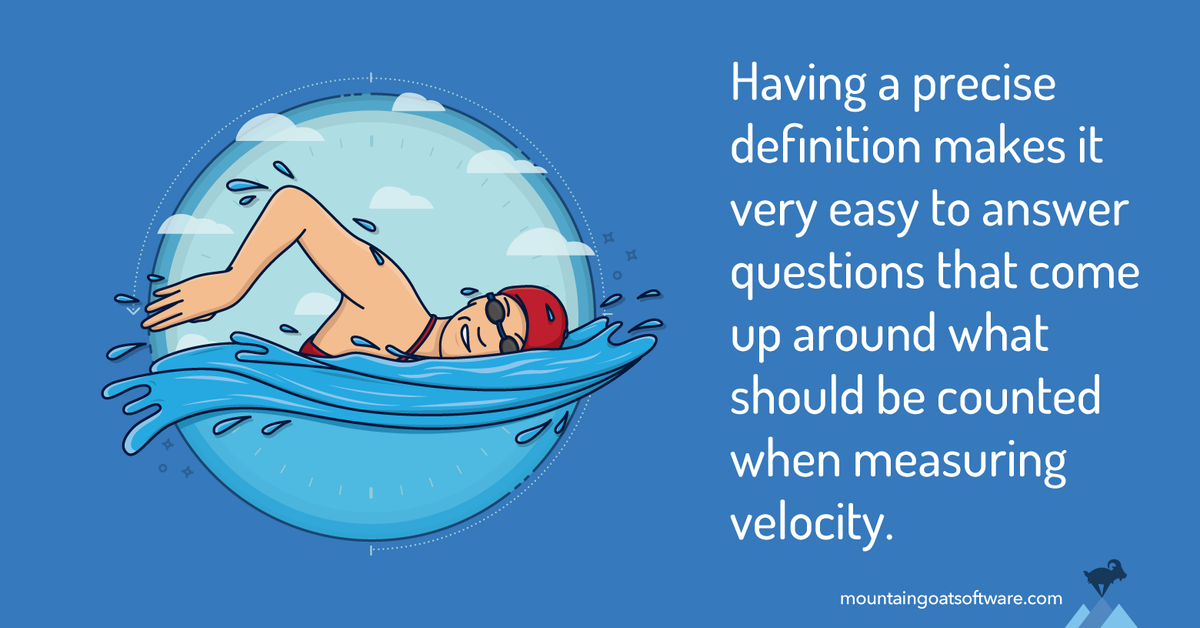
Those may sound the same. They are subtly different. To see how, suppose you hop in a river and begin swimming. After an hour, you measure how far you've traveled, and you are 2 kilometers from where you began. In agile terms, we might want to call this your velocity and say you swim 2 kilometers per hour or per sprint, if a swimming sprint is an hour long.
But, what if the river had been flowing at the rate of one kilometer per hour against you while you swam? In that case, you really swam 3 kilometers. Measured against the banks of the river, you've only moved two kilometers of physical distance. But while going forward two kilometers, you overcame being pushed backward one kilometer by the river.
So, is your velocity two or three? If we use our first definition—velocity is how much a team delivers in a sprint—then velocity is two. This swimmer delivered 2 kilometers of progress.
If we use our second definition—velocity is the ability to turn ideas into new functionality—then velocity is three. This swimmer has the ability to deliver 3 kilometers of progress per sprint, and we'd see that he was swimming in a lake with no current instead of a river.
To see how this applies to an agile project, consider the issue of whether a team should earn velocity credit for fixing bugs during a sprint. A team that uses velocity to measure how much functionality is delivered in a sprint will not claim credit for bug fixes. No new functionality has been delivered. So no points are earned.
A team using defining velocity as the ability to turn ideas into functionality, on the other hand, will claim credit for bug fixes. Their logic is that the time spent on bug fixing could have been spend adding new functionality except the product owner prioritized different work for them.
For many teams, the two definitions will yield the same value. Values will differ most for teams doing work for which they are not taking velocity credit--usually teams doing things like a lot of bug fixing or doing large amounts of refactoring.
Neither of these subtle differences in the definition of velocity is always better than the other. The one you use should largely depend on what you hope to learn by measuring it and by your expectations about the future.
If you expect the future to be just like today—that is, the team will spend the same amount of time doing bug fixing, refactoring and the like as they do now, then using velocity as a measure of how much forward progress is made will be the right answer for you.
However, if you expect the future to be different—perhaps the large refactoring and time spent fixing bugs will soon be over—then you may want to define velocity as the team's ability to turn ideas into functionality, and would then add to velocity the points given to those activities.
The most important thing is to clarify with everyone on the team, including the product owner and ScrumMaster, is exactly what your team means when they use the term “velocity.” Having a precise definition makes it very easy to answer questions that come up around what should be counted when measuring velocity.

Story Points
FeaturedStory points help agile teams estimate product backlog items by comparing one item with another. They are useful because teams rarely need perfect predictions.

Velocity Range
FeaturedA velocity range gives teams and stakeholders a more honest way to forecast than a single average velocity. Instead of saying, “This team will complete 33 points per sprint,” a team might say, “Based on recent…

How Product Owners Can Evaluate Refactoring Work
FeaturedLearn how product owners can evaluate refactoring when user-visible benefits are indirect.
What Happens When During a Sprint
Succeeding with Scrum is easier when you know when and why to conduct each of the Scrum events during the sprint.


Do Agile Teams Include Semi-Finished Work in Velocity?
Should teams receive partial credit on nearly finished stories when calculating their sprint velocity? Find out in this video blog from Mike Cohn.

The Just Right Size for Agile Teams
Find the team size that balances collaboration with overhead.
What Does a Product Owner Do, When, and Why?
Clarify what product owners do before work starts, during planning, and throughout each sprint.

Should Story Points Be Assigned to a Bug Fixing Story?
My usual recommendation is to assign points to bug fixing the agile defects. This really achieves the best of both worlds.

Predicting Velocity When Teams Change Frequently
As a measure of the amount of work completed in an iteration, velocity works extremely well when teams are relatively stable.

How to Estimate Story Points With Multiple Teams
Establishing a common baseline allows multiple teams to estimate consistently with story points.

Team Reset
Help a stuck Scrum team diagnose recurring problems, realign expectations, and choose practical changes.

Working on a Scrum Team
Help the whole Scrum team build a shared approach to roles, planning, refinement, collaboration, and finishing valuable work together.

Scrum Team Improvement
Strengthen team collaboration, Scrum practices, role clarity, and delivery.

Velocity Range Calculator
Use this to calculate a velocity range from historical sprint data and support milestone forecasting.

Team Improvement Sprints
Make focused improvements through short coaching engagements built around the team’s most important challenge.

Estimating
Build practical agile estimating skills with story points, planning poker, triangulation, velocity, and techniques for making useful forecasts without chasing false precision.

Plan Visualizer
The Plan Visualizer is a free agile forecasting tool for testing whether a target scope can be completed by a target deadline. It plots the plan against a low and high velocity estimate so teams and stakeholders can…

Accurate Agile Planning
Help teams create credible forecasts, plan under uncertainty, and make better decisions about scope, timing, risk, and tradeoffs.

Estimating & Planning
Improve estimates, forecasts, release planning, and conversations about scope, timing, and risk.