
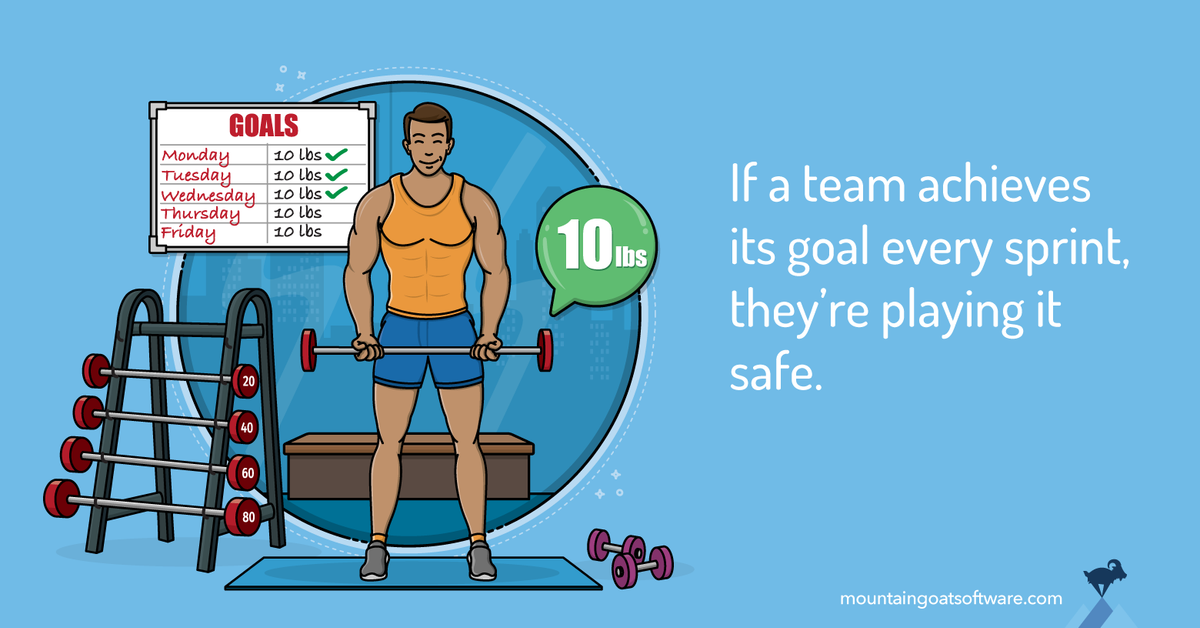
Naturally the goal in sprint planning is to plan a sprint that the team can successfully complete. Some teams will consider a sprint successful when the sprint goal is achieved. But not all teams are able to confine their sprints to a single goal; those teams may consider a sprint successful if team members complete all planned backlog items within the sprint.
But should teams strive to be successful in these ways every sprint?
70–80% Is a Win
No, they shouldn’t. If a team meets its goal or finishes all backlog items every sprint, that probably means the team is playing it safe when planning the sprint. Some teams are conservative in what they choose because of their own natures. Other teams are reluctant to disappoint stakeholders, so they assume an attitude of under-promising. Still others are fearful of being in trouble if they don’t successfully finish what was planned.
I advise teams to get their sprints right 70–80% of the time. If a team does what they say they will at that rate, this gives the organization plenty of predictability. Stakeholders can be told about the plan for the next sprint and reasonably believe the team will likely finish what they’ve planned.
Reasonable stakeholders will understand the sprint plan is not a guarantee, but that it is very likely. If I tell a friend I’ll meet him for dinner at 6:00, he knows I’ll very likely be there on time. But it’s not a guarantee. I’m not going to begin the drive from my house early enough to account for unexpected traffic, getting stuck at a train crossing, having a flat tire, and road construction that causes a detour, all on the same journey.
Finishing 100% of the work 70–80% of the time, allows a team to more aggressively plan each sprint. An item that might be achievable during a sprint now gets included. The same item would have been left out in a culture in which everything must be finished every sprint.
Setting a goal of getting it right most sprints, rather than every sprint, also enables teams to conduct sprint planning meetings more quickly. Saving time in meetings is always a win in my book.
What About When a Guarantee Is Needed?
There are times when stakeholders do need a guarantee of what will be delivered in a sprint. What should a team do then? In those cases, the team has two equally viable options.
First, team members can plan a sprint that includes only what they feel very confident they can deliver. In an example above I wrote that a team might bring an item into the sprint if they thought they could complete it but weren’t sure. If a guarantee is needed, they wouldn’t bring that item into the sprint.
Alternatively, the team can commit to some items in the sprint and identify others as stretch goals that may or may not be included.

Finish Everything Every Sprint
FeaturedIt sounds reasonable to expect an agile team to finish everything it plans every sprint. The team chooses the work.

Estimating & Planning in Agile: A 2026 Field Guide
FeaturedShare a practical 2026 field guide to agile estimating and planning, with current guidance for making useful forecasts without false certainty. Download a PDF of this you can share.

Should Scrum Teams Include a Stretch Goal In Their Sprints?
FeaturedDecide whether stretch goals help or create pressure in sprint planning.

Teams Don't Need to Think of Everything During Sprint Planning
Avoid over-planning every sprint task before work begins.

Should a Team Assign Work During Sprint Planning?
Some teams assign all tasks upfront. Others don’t.

An Agile Team Shouldn’t Finish Everything Every Iteration
Too often, agile teams are expected to finish everything every iteration. This expectation is harmful and wrong.

2 Times to Play Planning Poker and 1 Time Not To
I recommend using Planning Poker on product backlog items rather than on the tasks that make up a sprint backlog.

How to Stop Struggling with Sprint Planning
What are the danger signs that sprint planning is a struggle for your teams? And how can you turn it around?

When Do Agile Teams Make Time for Innovation?
Make space for innovation inside short sprint cycles.

Capacity-Driven Sprint Planning
Plan sprints around real team capacity instead of relying only on past velocity.

Why Agile Teams Should Estimate at Two Different Levels
It’s important for most agile teams to estimate both their product and sprint backlogs. But why?
Writing the Product Backlog Just in Time and Just Enough
Keep backlog detail just enough and just in time.

Why I Don’t Emphasize Sprint Goals
Sprint goals are considered a mandatory part of Scrum. Here’s why I disagree.

The Sprint Goal: What It Is and How It Can Help
Sprint goals are something every Scrum team should try to create. Learn what sprint goals are and what a good sprint goal looks like.
When You Miss the Point of Sprint Planning Meetings
Refocus sprint planning on shared understanding, not exhaustive task prediction.

3 Ways to Help Agile Teams Plan Despite Uncertainty
We might not like ambiguity, but it’s a fact of life. Find out how to plan with uncertainty in mind.

Product Backlog
A product backlog is a prioritized list of possible future work for a product. It helps the Product Owner and team decide what to build, fix, learn, or improve next.

Four Reasons Agile Teams Estimate Product Backlog Items
Estimating product backlog items provides benefits beyond predicting when a project will be finished.

Your Team Won’t Think of Everything in Sprint Planning Meetings. And That’s OK.
Your team is probably spending too much time in sprint planning meetings. Here’s how to spend less time but plan better.
Does Scrum Have Too Many Meetings?
Are teams complaining about Scrum meetings? Learn why that happens, and how to fix it.