

As a Scrum Master, you have certain responsibilities. And you also have rights that will enable you to succeed in your role. I’m going to share three rights you need to be effective. You can watch the video below or scroll down to read the article.
Effective Scrum Masters Have Access to Stakeholders
The first right of a Scrum Master is to have access to stakeholders and decision-makers.
I used to work on a call center systems project. The developers and the Scrum Master weren’t permitted to communicate with the stakeholders.
The call center agents were all nurses. The theory was that they were too busy to communicate with developers and the Scrum Master. (That same busyness was why they needed new software.)
But without being able to learn their needs firsthand, the software development team was making some bad decisions. Everything had to funnel through our product owner. The programmers resorted to stalking the nurses in the lunchroom. That was the only time that they could meet: when a nurse was on his or her break.
That project was ultimately successful. But the process could have been faster if the programmers and Scrum Master had more access to stakeholders and decision-makers. Access would have allowed them to make faster decisions and quicker pivots.
How does an effective Scrum Master help the team get feedback from stakeholders? Sprint reviews. These built-in Scrum events are the perfect time for developers to access stakeholders directly. If stakeholders aren't attending regularly, consider theseFour Questions to Fix Low Attendance at Your Sprint Reviews and the Top Seven Ways to Engage Stakeholders.
Effective Scrum Masters Find Space for Experimentation
Another characteristic of an effective Scrum Master is the freedom to experiment with new ideas.
I love the fact that the majority of the world now does two-week sprints. However, I think we lost something when we moved away from four-week sprints: the ability to experiment as frequently as we once did.
To see what I mean, consider a development team in those early days of Scrum. Those early Scrum teams would be doing four-week sprints.
Now, imagine it’s sprint planning, and that team is deciding between two options of how to achieve a goal.
One is the tried-and-true way. The second is possibly a better way—but it’s unproven. The new way may not work. . .but if it does, it will be better.
Dev teams often chose to take the riskier, breakthrough, innovative approach when working in four-week sprints. They knew that even if the experiment failed, they would have only spent three or four days on it. With a longer sprint, there would still be plenty of time to recover, to switch back to the safe approach.
Nowadays most agile teams have moved toward shorter sprints. The unintended consequence is that organizations have turned Scrum into a check-the-boxes process. If team members have finished all the items they said they would, the team is successful. . .but if they have not, they’ve failed.
(This tendency is why I contend that agile teams should not finish everything every iteration.)
With shorter sprints, teams have moved away from feeling safe with experimentation. And as they have, innovation has receded as well.
To be successful Scrum Masters, we must fight to establish experimentation as part of our company culture.
I’m not advocating reckless risks or experimentation during the last stage of a big project. However, there are moments during a project when it’s worth getting inventive with a creative solution that may not succeed.
My teams have found success with making room for experiments in a short sprint. We use the concept of tripwires to accelerate decision-making.
Scrum Masters Must Be Able to Address Issues Openly
We’ve talked about two rights of effective Scrum Masters: access to stakeholders and space for experimentation. Scrum Masters also need the right to address issues openly.
Your role as a servant leader Scrum Master includes identifying and addressing problems and issues that need attention. (And that starts with facilitating effective retrospectives.)
But if your company has a “shoot the messenger” culture, it will be hard for you to continue bringing up issues. You can’t be transparent when you’re criticized and maybe even personally attacked every time you highlight a problem.
To be effective, agile development teams and Scrum Masters need a company culture of psychological safety.

Meetings
FeaturedScrum meetings help a Scrum Team plan, coordinate, inspect, and improve during each sprint. Scrum officially calls these events.
3 Rights Every Effective Scrum Master Needs
FeaturedWe've heard about the Scrum Master role and responsibilities. But what about Scrum Master rights--those things effective Scrum Masters need to succeed in their role? To be successful, a Scrum Master has a right to expect at least 3 things from their company culture.

Effective Scrum Master
FeaturedHelp Scrum Masters improve facilitation, coaching, impediment removal, influence, and team ownership.

Top 7 Ways to Engage Stakeholders in Sprint Reviews
Poorly attended sprint reviews cause real problems. Fortunately there are easy fixes.

How to Engage & Help Busy Product Owners
With many competing pulls on their time, product owners can be hard to catch during a sprint. Learn how to help harried product owners seize opportunities to inspect and adapt outside the sprint review.

Be a Great Product Owner: Six Things Teams and Scrum Masters Need
See what teams and Scrum Masters need most from a product owner to make delivery smoother.

Four Questions to Fix Low Attendance at Your Sprint Reviews
It can sometimes be a challenge to get people to attend and then participate in sprint reviews. Here is advice on overcoming that problem.

New To Agile Or Scrum
Agile helps teams deliver value sooner, learn faster, and adapt when plans change. Use this guide to understand what agile is, how it differs from Scrum, when agile helps, and where to go next if you are just…

Does a Scrum Team Need a Retrospective Every Sprint?
Decide how often retrospectives should happen based on sprint length and team needs.

Does Scrum Have Too Many Meetings?
Are teams complaining about Scrum meetings? Learn why that happens, and how to fix it.

Four Common Scrum Master Mistakes–and How to Fix Them
Avoid these 4 pitfalls—like dodging tough talks—to become a more effective Scrum Master.
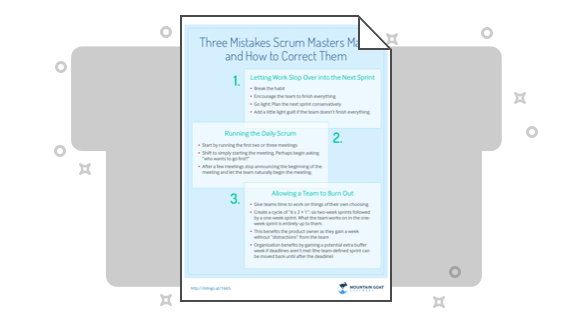
Three Mistakes Scrum Masters Make
Learn three common mistakes Scrum Masters make, why they hurt teams, and what to do differently with this quick reference sheet. Get a copy of the _Three Mistakes Scrum Masters Make and How to Correct Them_ reference

The Sprint Goal: What It Is and How It Can Help
Sprint goals are something every Scrum team should try to create. Learn what sprint goals are and what a good sprint goal looks like.

The Chivalrous Team Member
Recognize helpful behavior that strengthens collaboration and trust.

Self-Organizing Teams, their Benefits, and a Leader’s Role
Explore self-managing teams, including the role of leaders and outcomes of effective teamwork.


Short Answers to Your Big Questions about Scrum Masters
Mike answers three common questions about Scrum Masters, including who Scrum Masters report to.

8 Reasons Scrum Is Hard to Learn (but Worth It)
Transitioning to Scrum is worth it, but some aspects are challenging.

The Five Pillars of a Successful Agile Transformation
Discover the secret to a successful agile transformation and learn what to try if your organization is struggling.

When Do Agile Teams Make Time for Innovation?
Make space for innovation inside short sprint cycles.