
Using a One-Handed Clock to Convey Project Goals
The "iron triangle" is a long-accepted way of talking about the four parameters of project success. In the iron triangle, scope, schedule and budget each takes its place along a side of the triangle. Quality is placed in the middle under the premise that we don't mess with quality. We can, however, adjust the sides. Sometimes a product owner or key stakeholder is told, "Pick any two but I can adjust the third" by the project manager, ScrumMaster or coach. Sometimes the customer is told, "you can only lock down one of the sides." I've recently decided there's a better way to convey the points we've been trying to make with the iron triangle--we use The One-Handed Clock of Project Goals. To use the one-handed clock, position Scope, Schedule and Budget where twelve o'clock, four o'clock, and eight o'clock would be on a clock. It doesn't matter which is positioned where but I put them as shown in the figure. Quality is again assumable fixed and not needed on the clock.
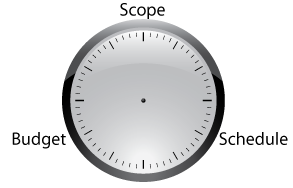
Next, ask the product owner or key stakeholder to point the one hand where it best indicates the project's goals. The one hand can be aimed, for example, directly at Schedule. This would indicate that Schedule is the most important goal and Scope and Budget both take a back seat to it.
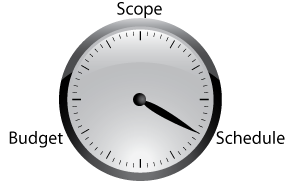
Or perhaps the one hand is pointed between Scope and Schedule showing a mix of importance between them.
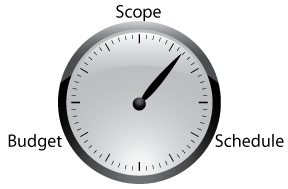
To see how the One-Handed Clock of Project Goals works, take a moment to think about it. You can position the hand anywhere between any two of three goals but one goal is always left out. In the terms of the iron triangle, that would be the side left flexible. There are a lot of things I like about this new way of visualizing the relative importance of Scope, Schedule and Budget. I'll mention two here:
-
The One-Handed Clock allows stakeholders or product owners to convey a position more precisely than saying something like "I pick Schedule and Budget." The ability to point the arrow precisely rather than only directly at an item is essential.
-
The One-Handed Clock is a useful visual metaphor that can be hung in a team room. The iron triangle doesn't really work for that as it's hard to convey which sides were selected other than by darkening them, which doens't show much.
The teams and product owners I've introduced it to so far have found it to be a very helpful agile project management tool. I suspect you will as well.

Project Success Sliders
FeaturedProject Success Sliders are a way for key project stakeholders or a product owner to convey their expectations to the team. By default there are six sliders, each of which reflects some dimension by which agile…

Leading Agile Initiatives
FeaturedAgile initiatives succeed when leaders use agile itself to improve agility: clear goals, short feedback loops, visible leadership support, and practical experiments that help teams work better. This guide helps…

What Are Product Goals & When Do Product Owners Create Them?
Featured01:00 What is a product goal? 02:33 Why product goals are important for agile teams 03:59 What is the right timescale for a product goal.

ScrumMaster: Appointed or Team-Selected?
Consider when Scrum Masters should be appointed versus selected by the team.

Product Owner
The Product Owner is accountable for maximizing the value of the product created by the Scrum Team. That means the Product Owner decides what matters most, orders the Product Backlog, communicates the Product Goal,…

Six Guidelines for Saying No to a Stakeholder
Learn how to say no to stakeholder requests while preserving trust and keeping focus on value.

Should You Become a Product Owner?
Explore the skills, paths, and tradeoffs to consider before stepping into the product owner role.
What Does a Product Owner Do, When, and Why?
Clarify what product owners do before work starts, during planning, and throughout each sprint.