
When Should We Estimate the Product Backlog
I was recently emailed a question asking whether the sprint planning meeting should start with time allocated for putting story point estimates on any user stories that have not yet been estimated. No, I don't think this is a good idea. Keep in mind that we put estimates on product backlog items (which I recommend be user stories) so that:
-
the product backlog can be prioritized. It is impossible to fully prioritize a set of items without knowing at least their relative cost.
-
we can make high-level forecasts about how much will be done by when
-
we can make tradeoff decisions between scope and schedule
We can achieve these goals with approximate, relative estimates such as given by story points. For example, if I decide to buy a new car this weekend it is sufficient for me to know that I can get a Toyota or Honda for around $30,000 and that a Ferrari goes for closer to $800,000. I do not need to know a more precise cost of the Honda ($31,850) before knowing it should be on my short list of cars to evaluate while the Ferrari should not. Sprint planning meetings typically go into deeper detail than is appropriate for product backlog item estimating (whether in story points or ideal days). Since we become accustomed during sprint planning to breaking user stories into tasks and considering those tasks in more detail, there is a chance this will carry over into any story point estimating done during the same meeting. So, when should story point estimating happen? I'll describe the ideal case, which you can easily adjust for the real-world intrusions on your project. Projects typically start in either of two ways:
-
A reasonably fully stocked product backlog is written before the first sprint begins and all items are estimated before the first sprint planning meeting. [If you do this, be careful not to write all user stories with too much detail. Each product backlog item you write represents an investment. User stories should therefore be elaborated just-in-time and in just-enough detail that they can be turned into functionality in one sprint.]
-
We know we've got to do the project so we dive in. During the first sprint or two, all the user stories are written and estimated just like above.
On an ongoing basis, once per sprint I recommend that the ScrumMaster tell the team something like, "Hey, we've had five new user stories come in this sprint and we need to estimate them. Everyone plan on hanging around for a bit after tomorrow's daily scrum meeting and we'll play Planning Poker to estimate the new items." Doing it right after the daily scrum helps cut down on the number of interruptions in total. I usually aim for having that meeting about two days before the end of the sprint. That way the product owner will have estimates on them so she can prioritize prior to the start of the sprint.

2 Times to Play Planning Poker and 1 Time Not To
FeaturedI recommend using Planning Poker on product backlog items rather than on the tasks that make up a sprint backlog.
Why I Don't Use Story Points for Sprint Planning
FeaturedI don't use story points for sprint planning because story points are a useful long-term measure. They are not useful in the short-term.
What Happens When During a Sprint
FeaturedSucceeding with Scrum is easier when you know when and why to conduct each of the Scrum events during the sprint.

Product Backlog
A product backlog is a prioritized list of possible future work for a product. It helps the Product Owner and team decide what to build, fix, learn, or improve next.

Product Owner
The Product Owner is accountable for maximizing the value of the product created by the Scrum Team. That means the Product Owner decides what matters most, orders the Product Backlog, communicates the Product Goal,…
Product Backlog Refinement Checklist
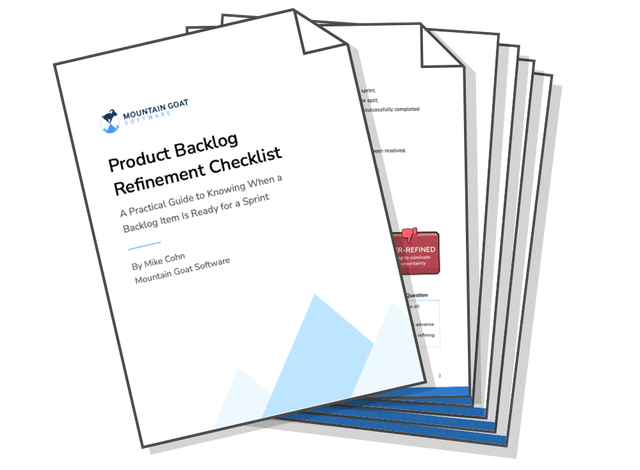
Bring this practical checklist to your next refinement session to decide whether backlog items are clear and ready enough for a sprint. Download The Product Backlog Refinement Checklist and use it in your next…

Backlogs
Learn how to shape, prioritize, refine, and size product and sprint backlogs so teams can focus on valuable work that is ready at the right time.
To Re-estimate or not; that is the question
When we estimate it is important that we not mix knowledge-before-the-fact with knowledge-after-the-fact.

Estimating & Planning
Improve estimates, forecasts, release planning, and conversations about scope, timing, and risk.

What Are Agile Story Points?
Understand what story points measure and why they are often misunderstood.

Why Agile Teams Should Estimate at Two Different Levels
It’s important for most agile teams to estimate both their product and sprint backlogs. But why?

Story Critic
Story Critic is a free AI coach for improving backlog items without turning them into miniature specifications. It helps developers, testers, analysts, designers, and product owners make user stories, job stories,…
Estimating
Build practical agile estimating skills with story points, planning poker, triangulation, velocity, and techniques for making useful forecasts without chasing false precision.

Mastering User Stories
A one-day course where your team improves real backlog items while learning how to write, split, and refine better stories.

Plan Visualizer
The Plan Visualizer is a free agile forecasting tool for testing whether a target scope can be completed by a target deadline. It plots the plan against a low and high velocity estimate so teams and stakeholders can…

Story Writing Workshop
Improve real backlog items in a facilitated workshop so teams can practice user stories with work they actually need to deliver.

Backlog Story Improvement
Improve backlog quality, story splitting, refinement, and the flow of work from idea to delivery.

Backlog Refinement Workshop
Improve refinement using real backlog items so planning is clearer and faster.

Accurate Agile Planning
Help teams create credible forecasts, plan under uncertainty, and make better decisions about scope, timing, risk, and tradeoffs.

Velocity Range Calculator
Use this to calculate a velocity range from historical sprint data and support milestone forecasting.