
A Note on the Term “Chief Product Owner”
The labels “chief product owner” and “product line owner” are the ones I generally favor, but they are representative only; use others if you wish. In addition to these, I’ve seen both program owner, super product owner, area owner and feature owner used successfully.
For consistency with the bulk of existing Scrum literature, I prefer to use “product owner” for the individual who works directly with one or two teams, prioritizing their work and doing all of the other things associated with the product owner role. In these multilayer hierarchies, the product owner is often someone whose business card reads: “Business Analyst.”
The product owner role can be one of the most challenging on a Scrum project.
On all projects, the product owner is torn between competing inward-facing and outward-facing needs. Among the inward-facing tasks are participating in planning meetings, sprint reviews, sprint retrospectives and daily scrums; managing the product backlog; answering questions from the team; and simply being available to the team during the sprint.
A product owner’s outward-facing tasks include talking to users about their needs; creating and interpreting user surveys; traveling to customer sites; attending industry trade shows; managing stakeholder expectations; prioritizing the product backlog; determining product pricing; developing a medium- and long-term product strategy; watching for industry and market trends; performing competitive analysis; and more.
Too Much for One Person to Do
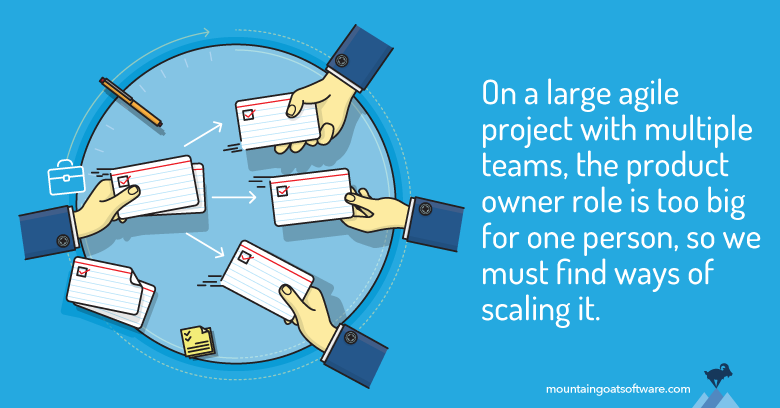
On a project with one team of developers, this can be a vast but achievable amount of work. On a large project with multiple teams, however, the product owner role is too big for one person, so we must find ways of scaling it.
As a project grows to include multiple teams, ideally a new product owner is found for each. If you cannot achieve a one-to-one correspondence between teams and product owners, try to have each product owner responsible for no more than two teams. This is usually the most that one product owner can effectively work with.
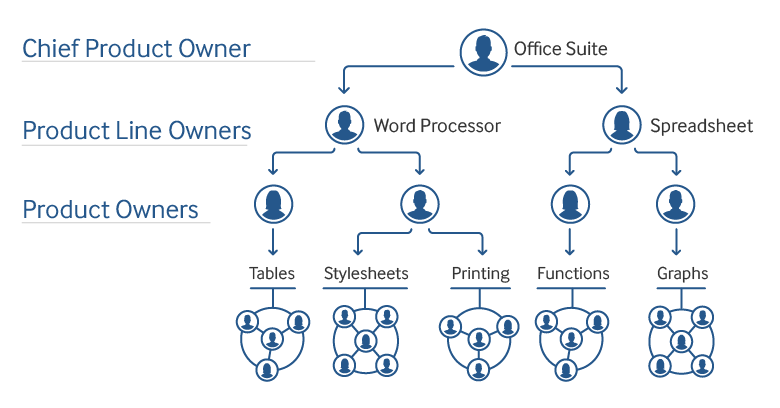
At some point, as the overall size of the project grows, it makes sense to introduce a hierarchy of collaborating product owners. The figure below shows such a hierarchy, with a product owner working with each team, two product line owners each working with a cluster of teams and a chief product owner. Naturally, layers can be added or removed as needed for the scale of the project.
Sharing Responsibility, Dividing Functionality
A chief product owner is responsible for having an overall vision of the entire product or product suite. The chief product owner conveys this to the entire team in whole-team meetings, e-mails, team get-togethers and through whatever other means are available.
But the chief product owner is almost certainly too busy to assume hands-on responsibility for working as the actual product owner for one of the five- to nine-person teams building the product. At this level, the external-facing requirements of the role are too great.
A good chief product owner will be very involved with teams—attending daily scrums occasionally, walking through team areas whenever in the office, and offering support and feedback. But the chief product owner will need to rely on the product line owners and product owners to handle the intricate details of their product segments within the overall project vision.
An Example of a Chief Product Owner and Product Line Owner
Suppose, for example, we decide to develop an office productivity suite that will include a word processor, spreadsheet, presentation software and personal database. Competing with Microsoft Office, Google Apps and other products will be daunting, but our chief product owner is fearless.
Because the chief product owner will be focused on strategic issues, competitive positioning and such, product line owners are selected to own the individual products in the suite—the word processor, spreadsheet, presentation program and database.
Each product line owner in turn identifies product owners who will be responsible for feature areas within the product. The product line owner for the word processor, for example, may work with one product owner who is responsible for tables, another responsible for stylesheets and printing, another who is responsible for the spell checker and so on.
Although as previously mentioned, the chief product owner is too busy to be the product owner for one team, it is possible for a chief product owner to act as the product line owner for part of the product.
Continuing with the preceding example, our chief product owner may choose to also be the product line owner responsible for the word processor, perhaps because of being in that role previously.
Similarly, a product line owner will often want to stay involved in a more hands-on manner and will work also as one of the product owners. Perhaps our product line owner for the spreadsheet product also acts as the product owner for the team that will add charts to the spreadsheet product.
Although functionality can be divided along these lines, it is important for all product owners to feel a shared responsibility for the full product. They must also instill this feeling of shared responsibility in the teams they work with.

Product Ownership
FeaturedProduct ownership is the ongoing work of maximizing the value of what a team builds. The Product Owner role in Scrum makes that work visible and accountable, but effective product ownership is bigger than one job title.
What Is a Product?
FeaturedDefine products clearly so backlogs, teams, and ownership make sense.

Meetings
FeaturedScrum meetings help a Scrum Team plan, coordinate, inspect, and improve during each sprint. Scrum officially calls these events.
What Does a Product Owner Do, When, and Why?
Clarify what product owners do before work starts, during planning, and throughout each sprint.

Effective Product Owner
Help product owners make clearer priorities, backlog decisions, and stakeholder tradeoffs.
Be a Great Product Owner: Six Things Teams and Scrum Masters Need
See what teams and Scrum Masters need most from a product owner to make delivery smoother.

Product Owner
Explore the Product Owner role, from deciding whether it fits you to setting product goals, prioritizing the backlog, engaging stakeholders, and making better product decisions.

Certified Scrum Product Owner
Build practical product ownership skills and earn Scrum Alliance Certified Scrum Product Owner certification.

Advanced Certified Scrum Product Owner
Private Advanced Certified Scrum Product Owner course for experienced product owners who want stronger product judgment, stakeholder leadership, and A-CSPO certification.
How to Estimate Story Points With Multiple Teams
Establishing a common baseline allows multiple teams to estimate consistently with story points.
5 Reasons Product Owners Should Let Teams Work Out of Order
See when letting teams work out of strict backlog order can improve flow and outcomes.

The Sprint Review as a Sign-Off Meeting
Decide whether sprint reviews should be used as formal sign-off meetings.
Top 7 Ways to Engage Stakeholders in Sprint Reviews
Poorly attended sprint reviews cause real problems. Fortunately there are easy fixes.

Sprint Review: More Than Just A Demo
There’s much more to a sprint review than just a demo. Discover the purpose of a sprint review and why calling it a demo is a bad idea.

Should the Daily Scrum Be Person-by-Person or Story-by-Story?
Choose whether to discuss work person-by-person or story-by-story in daily scrum.

Should You Become a Product Owner?
Explore the skills, paths, and tradeoffs to consider before stepping into the product owner role.
Don't Defer a Meeting Because One Person Can’t Attend
Learn when to hold Scrum events even if one person cannot attend.

How Product Owners Can Evaluate Refactoring Work
Learn how product owners can evaluate refactoring when user-visible benefits are indirect.

Multiple Levels of Done
Define done at more than one level so expectations stay clear from story to release.