

Most user stories can be split. It may be hard to find a good way to split some stories, but most can be split. These are known as *compound* stories—stories that are made up of multiple smaller stories.
There is another type of story: the complex story. Complex stories are ones that cannot be split. They are inherently large or complex and there are no subparts to be pulled into separate stories.
Even with a complex story, you don’t want to let the story linger open for three, four or more sprints. Doing so
-
Makes velocity less predictable from sprint to sprint
-
Increases the risk of a developer going astray from user expectations , and
-
Allows the team to develop the bad habit of leaving work incomplete at the end of an iteration
Use Progress Points to Identify Accomplishments
So, what is a good, agile team to do?
When it’s impossible to find a good, natural split that results in two or more smaller, functional stories look instead for progress points.
A progress point is any point during the development (usually coding) of a feature at which the developer feels something has been accomplished.
No developer wants to go two months without the job satisfaction of being able to tell teammates, “I got such-and-such accomplished.”
To identify progress points, ask the developer who is engaged with a complex story, “Where are the points while working on this where you’ll want to tell a tech-savvy teammate, ‘Dude, check it out! I got the this-and-that to work!’”
Examples of Progress Points
As an example, suppose a developer is working on some complex code to interact with a remote system. The developer expects to need two or three iterations to be done.
A progress points on that could be that a first transaction is sent to (or received from) the other system. No error checking or handling is performed but a first exchange with the other system would be a point at which the developer might share the accomplishment with a second tech-savvy teammate who understands the significance of the accomplishment.
A second progress point could be more transaction types being exchanged, errors being detected, or errors being retried.
Once identified, many of these progress points can be quite readily expressed as user stories. So, thinking of progress points helps developers identify natural milestones they’ll reach during the implementation of a large story.
Using a Story’s Progress Points
Having identified one or more progress points within a complex story, use those as milestones. Ask the developer to identify how many of the progress points can be completed during the coming iteration and then use that to track progress just as you would a regular user story.
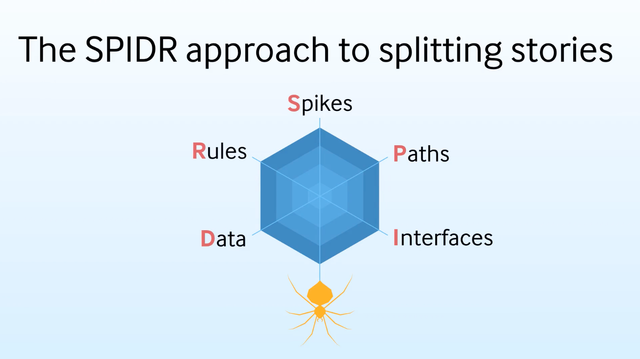
Story Splitting Video
FeaturedLearn five practical SPIDR techniques for splitting oversized stories into smaller, valuable work in this free video lesson. Stop wasting time splitting stories!

Mastering User Stories
FeaturedA one-day course where your team improves real backlog items while learning how to write, split, and refine better stories.

Advice on How to Split Reporting User Stories
FeaturedSee examples for splitting reporting stories into smaller, useful pieces.

Good User Stories
A good user story helps the team make better decisions and move work toward delivery. It does not need perfect wording.

Story Points
Story points help agile teams estimate product backlog items by comparing one item with another. They are useful because teams rarely need perfect predictions.

What Are Agile Story Points?
Understand what story points measure and why they are often misunderstood.

User Stories
Learn how to write, refine, split, and map user stories that help agile teams understand customer needs and deliver valuable outcomes.

Writing User Stories for Back-end Systems
Write user stories for backend systems where users are less obvious.

How to Split Any User Story with SPIDR
Need to split a user story that’s too big for a sprint? In this video, Mike Cohn explains SPIDR, a simple and memorable method for splitting user stories into smaller, more manageable pieces of work. SPIDR gives agile teams five practical ways to split large stories, epics, and features so they are easier to estimate, discuss, and deliver.

Don’t Equate Story Points to Hours
Story points are about time, specifically effort. But that does not mean you should say, “One story point = eight hours.

Story Critic
Story Critic is a free AI coach for improving backlog items without turning them into miniature specifications. It helps developers, testers, analysts, designers, and product owners make user stories, job stories,…

Story Writing Workshop
Improve real backlog items in a facilitated workshop so teams can practice user stories with work they actually need to deliver.

Why I Don't Use Story Points for Sprint Planning
I don't use story points for sprint planning because story points are a useful long-term measure. They are not useful in the short-term.

Multiple Levels of Done
Define done at more than one level so expectations stay clear from story to release.

Write Better User Stories in Less Time With Less Aggravation
In this webinar, Mike Cohn shares three practical techniques for writing better user stories with less time and frustration. He explains how periodic story-writing workshops help teams look beyond the next sprint,…

How to Estimate Story Points With Multiple Teams
Establishing a common baseline allows multiple teams to estimate consistently with story points.

SPIDR: Five Simple but Powerful Ways to Split User Stories
Splitting user stories is hard. Here are the only five techniques you need to be able to slice any user story into small, manageable chunks of work.

Backlog Story Improvement
Improve backlog quality, story splitting, refinement, and the flow of work from idea to delivery.

Backlog Refinement Workshop
Improve refinement using real backlog items so planning is clearer and faster.