
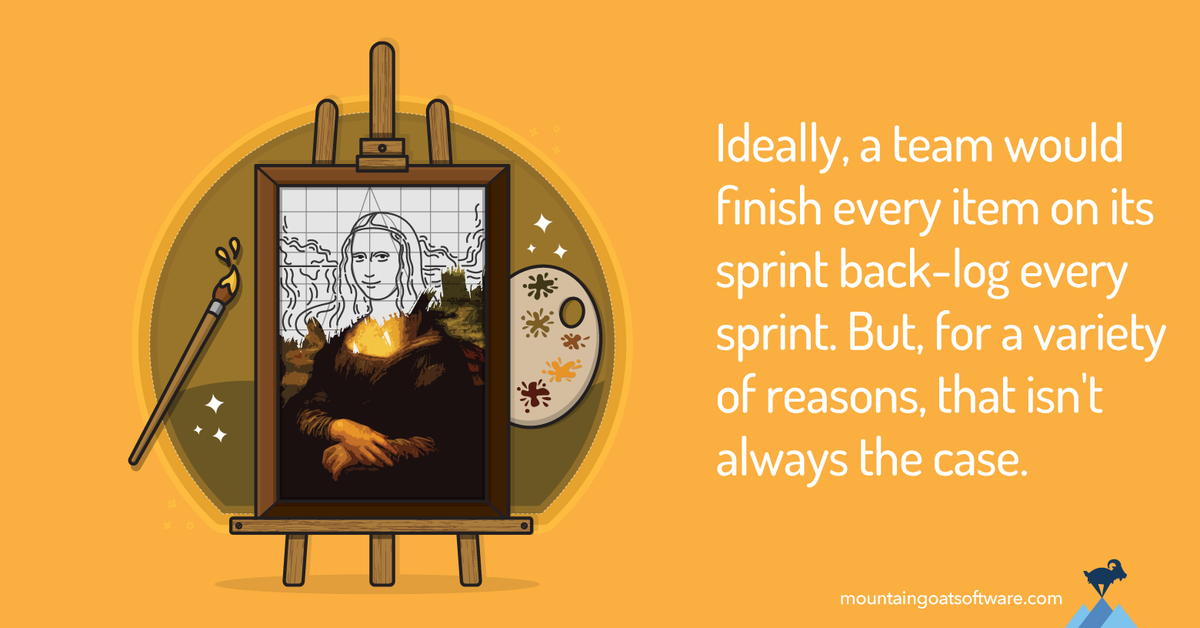
It’s quite common for a team to have a bit of unfinished work at the end of an agile sprint or iteration. Ideally, a team would finish every item on its sprint backlog every sprint. But, for a variety of reasons, that isn’t always the case. This leads to a couple of questions I’ll address here:
-
What should be done with the product backlog item itself?
-
Should be it split or should it be carried it into the next sprint?
-
Should the team receive any velocity “credit” for completing a portion of the story?
First, Be Sure the Item Is Still Important
When a product backlog item is not finished at the end of an agile sprint, it should first technically be put back onto the product backlog. Work never moves automatically from one sprint to the next.
I’m perhaps being overly pedantic here, but the point is that each sprint begins with the product owner making a conscious, deliberate decision about what the team should work on. If there’s unfinished work from the prior sprint, it’s very likely the product owner will want the team to finish that work in the new sprint. But, the product owner should still make an actual decision to do that.
(As a note, let me also say that I’m not suggesting you make extra work for yourself if you are using a tool that would make this difficult. All I’m saying is that work does not automatically move into the next sprint. The product owner must decide if the work is still valuable.)
Splitting or Carrying the Item Forward
When a product backlog is unfinished, teams are often torn on whether they should leave the product backlog item description alone (even though part of that functionality might be complete) or rewrite it to describe just the missing piece.
For example, consider a team building typical print preview functionality in a desktop application. If the team builds everything but the ability to page backward through the pages, it can either carry forward the original user story or write a smaller, replacement story like, “As a user, I can page backward while on the print preview screen.”
I recommend that if you are going to finish the story in the coming sprint, just leave it alone. Don’t rewrite it. Everyone is used to it as it’s written. Assuming it’s still of value to the product owner, it moves forward exactly as written.
However, if the remaining work will be deferred to a later sprint, write a new story that describes just that subset of functionality.
Does the Team Earn Velocity Credit
I always want to take a conservative stance towards calculating velocity. This means that a team should only take credit for work that is truly complete.
So, in the case the unfinished product backlog item is rolling forward to be completed in the next agile sprint, do not take any velocity credit. The team instead earns all credit in the sprint in which the work is finished. Since I advocate working with average velocities anyway, this averages out and avoids the risk of overstating velocity.
But when the team splits the story and puts the remaining subset onto the product backlog to be done in the future, go ahead and take some amount of velocity credit. The team will need to do its best to estimate a fair number of points for the subset of work that was completed. And, even though it did not finish the entire original story, the team may give itself all the original points if it feels the story was larger than originally planned. I’d be reluctant to do that very often. But, it is OK.
Always Look for a Root Cause
Finally, whenever work is unfinished at the end of an agile sprint, the team should take time in the retrospective to consider whether it was caused by something preventable. Sometimes, it’s just bad luck or bad timing, such as a team member becoming ill or a problem being found late in the sprint that could not have been found earlier. But, it’s always worth considering whether there is a root cause and whether something can be done to prevent it from affecting future sprints.

Should You Re-Estimate Unfinished Stories?
FeaturedWe avoid having unfinished work at the end of a sprint, but it sometimes happens. Here’s what to do.

Product Owner
FeaturedThe Product Owner is accountable for maximizing the value of the product created by the Scrum Team. That means the Product Owner decides what matters most, orders the Product Backlog, communicates the Product Goal,…
Do Agile Teams Split Unfinished Work for Velocity Credit?
FeaturedCan teams ever split unfinished work off of sprint backlog items that are close to being done and count the finished work toward their velocity? Learn about 2 problems with late-sprint splits of unfinished stories, the one time I allow story splitting during a sprint, and the positive side effects of enforcing the rules.
Scrum Reset Diagnostic
Scrum feeling heavy, slow, or unfocused? Find the one problem to fix first and run a practical two-sprint reset.

What Are Agile Story Points?
Understand what story points measure and why they are often misunderstood.

User Stories
User stories help agile teams move from documenting requirements to understanding them. This guide explains what user stories are, how to write them, how to recognize good stories, and how to use practices such as…

Minimize Spillover in Agile: Break the Habit of Unfinished Work
When too many sprints end with unfinished stories, it’s time to take action. Here’s how.
What Does a Product Owner Do, When, and Why?
Clarify what product owners do before work starts, during planning, and throughout each sprint.

Do Agile Teams Include Semi-Finished Work in Velocity?
Should teams receive partial credit on nearly finished stories when calculating their sprint velocity? Find out in this video blog from Mike Cohn.

Why I Don't Use Story Points for Sprint Planning
I don't use story points for sprint planning because story points are a useful long-term measure. They are not useful in the short-term.

Don’t Estimate the Sprint Backlog Using Task Points
Some teams like story points so much, they invent task points and use those for sprint planning. Bad idea.

When Should We Estimate the Product Backlog
Estimate backlog items at the right time and level of detail.
Should You Use Zero-Point Estimates on Your Product Backlog?
Understand when a zero-point estimate is useful and when it hides real work.

What Product Owners Do & 7 Mistakes to Avoid
Use seven common product owner mistakes to spot where ownership, prioritization, or collaboration may be breaking down.

Don’t Equate Story Points to Hours
Story points are about time, specifically effort. But that does not mean you should say, “One story point = eight hours.

How to Use AI for Product Discovery and Writing Better User Stories
Use AI to support product discovery, user interviews, and writing better user stories.

Five Story-Splitting Mistakes and How to Stop Making Them
There are plenty of mistakes a team can make when splitting user stories. Here are five of the most common.

Writing the Product Backlog Just in Time and Just Enough
Keep backlog detail just enough and just in time.

What Happens When During a Sprint
Succeeding with Scrum is easier when you know when and why to conduct each of the Scrum events during the sprint.
Estimates on Split Stories Do Not Need to Equal the Original
Understand why split story estimates do not need to add up to the original.