
Is It a Good Idea to Establish a Common Baseline for Story Points?
In a previous post, I wrote about how to establish a common baseline for story points across relatively large teams (a few hundred developers). In this post I want to consider whether doing so is a good idea. The need for a common baseline to story points usually arises from the reasonable desire to know how big the entire project is. To know that, we must know the size of the work to be done by each team.
Unfortunately, along with this goal comes the ability to compare teams based on their velocities. Since many managers are constantly looking for ways to compare team and individual performance it is not surprising that they begin to make such velocity comparisons. Almost all such comparisons are disruptive to performance of the combined, overall group or department. A chart such as the one that follows can show a lot of interesting information.
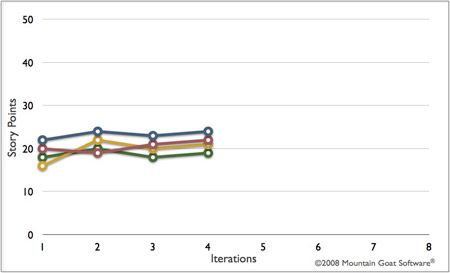
However, this chart can be very dangerous because of how teams will assume the data is being interpreted. Shown a chart like this a common team response will be to feel that they need to faster than the other teams. Achieving this additional speed may come from working in a more focused manner (a good thing), but it may come instead from sacrificing quality, leaving important refactorings undone, or a variety of other not-so-good manners.
Some teams may respond to the pressure for their abstract measure of velocity to increase by gradually inflating the number of story points assigned to a story. This can happen in subtle and not particularly nefarious ways that can accumulate into large problems. Consider, for example, a team that is arguing over whether a particular story should be estimated at 5 or 8 points. If the team is under pressure (real or just perceived) to increase velocity they will be more likely to assign the 8.
The next story the team considers is slightly larger. They compare it to the newly assigned 8 and decide to give it a 13. Without pressure to improve velocity, this same team may have given the first item a 5 and the second (slightly larger still) item an 8. In this one scenario the team has inflated their points from 5+8=13 to 8+13=21, or more than 50%. Story point inflation such as this tends to happen very quickly if it happens at all. Consider what happened in the next few iterations for the four teams shown in the previous figure.
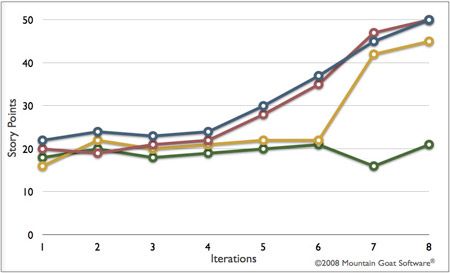
Not surprisingly, someone in the Project Management Office distributed the chart showing the similarities over the first three iterations. Two of the teams reacted by instantly inflating their story points. After seeing that, the yellow team followed suit. The green team is either extremely virtuous or they haven't noticed the charts yet.
So, should you establish a common baseline? Yes, if there are advantages to doing so on your project. If you do, however, you need to make sure you go out of your way to create safety around that baseline for the teams. Stress that this isn't being done as a way to compare teams and that you (and your bosses know) that there are many factors that influence velocity, not just "how good" a team.
For more on agile estimating and planning, check out Planning Poker.

Story Point Baselines
FeaturedStory point baselines give a team familiar examples to compare against. Relative estimation works best when the team can point to completed or well-understood product backlog items and say, "This is what we mean by…

A Second Way to Prevent Estimate Inflation
FeaturedLearn one more practical technique for preventing estimate inflation and keeping your team's story point estimates useful over time. Go beyond the blog post - find out one more way to prevent estimate inflation.
Establishing a Common Baseline for Story Points
FeaturedA common criticism of story points is that the meaning of a story point will differ among teams.

How to Estimate Story Points With Multiple Teams
Establishing a common baseline allows multiple teams to estimate consistently with story points.

Is It Dangerous to Calculate the Cost per Point?
Calculating a cost per story point comes with risks. Here's what you need to know.

The Best Way to Establish a Baseline When Playing Planning Poker
Establish useful baselines so Planning Poker estimates stay relative.

Estimating
Build practical agile estimating skills with story points, planning poker, triangulation, velocity, and techniques for making useful forecasts without chasing false precision.

What Are Agile Story Points?
Understand what story points measure and why they are often misunderstood.

Estimating & Planning
Improve estimates, forecasts, release planning, and conversations about scope, timing, and risk.

When Planning Should Become A Shared Problem
Turn planning pressure into a shared conversation about options and tradeoffs.

Plan Visualizer
The Plan Visualizer is a free agile forecasting tool for testing whether a target scope can be completed by a target deadline. It plots the plan against a low and high velocity estimate so teams and stakeholders can…

Velocity Range Calculator
Use this to calculate a velocity range from historical sprint data and support milestone forecasting.

Accurate Agile Planning
Help teams create credible forecasts, plan under uncertainty, and make better decisions about scope, timing, risk, and tradeoffs.