

A Practical Guide to Doing It Right
Refinement helps teams create enough shared understanding to plan with confidence.
Product backlog refinement is one of the most misunderstood practices in Scrum.
Teams either underinvest in it and suffer through painful Sprint Planning meetings… or they overinvest in it and try to eliminate every possible uncertainty before starting work.
Neither extreme works.
Done well, product backlog refinement is the hidden engine of predictable delivery. It improves planning, increases throughput, reduces frustration, and strengthens trust between the Product Owner and the team.
Done poorly, it leads to long planning meetings, missed sprint goals, and growing skepticism about estimation.
This guide explains what product backlog refinement is, how much is enough, and how to structure it so it improves results rather than consuming time.
What Is Product Backlog Refinement?
Product backlog refinement is the ongoing activity of developing a deeper, shared understanding of upcoming backlog items so the team can determine whether they can complete them within a sprint.
That’s the purpose.
You may also hear this called backlog grooming, though I prefer the term refinement because it better reflects what should happen: the team progressively improves and clarifies upcoming work.
Product backlog refinement is an ongoing activity that supports Sprint Planning by ensuring the team does not encounter backlog items for the first time during the planning meeting. Scrum does not make refinement a formal event, but many teams benefit from a regular rhythm for it.
Refinement is not:
- Writing detailed specifications
- Eliminating all uncertainty
- Designing every solution in advance
- Done alone by the Product Owner
At its core, product backlog refinement answers one question:
Do we understand this item well enough to believe it will fit in a sprint?
If the answer is yes, refinement of that item can stop.
If the answer is no, refinement continues—until the sprint-threatening uncertainties are resolved.
Why Product Backlog Refinement Matters
When refinement is weak, the symptoms show up downstream.
Sprint Planning takes too long.
Stories turn out to be larger than expected.
Teams have to split items during planning.
Challenging edge cases surface late.
The team leaves sprint planning exhausted… and then doesn’t meet its sprint goal.
It’s easy to assume the team has a planning problem.
Most of the time, they don’t.
They have a refinement problem.
But the deeper cost is trust.
When teams repeatedly miss sprint goals, trust erodes between the Product Owner and the team. Team members start to question whether sprint planning is worth doing at all:
Why bother planning when so much is uncertain?
In some organizations, the problem spreads beyond the team. Stakeholders start looking for someone to blame.
Strong product backlog refinement reduces mid-sprint surprises, improves sprint goal achievement, and increases confidence in the team.
How Much Product Backlog Refinement Is Enough?
The most common mistake teams make is trying to eliminate all uncertainty.
They treat refinement as a quest for certainty. They want every edge case identified, every acceptance criterion finalized, and every design decision made.
That sounds responsible.
It isn’t.
Trying to eliminate all uncertainty:
- Slows teams down
- Creates analysis paralysis
- Wastes effort on work that may never be built
- Encourages false precision
The goal of product backlog refinement is not certainty.
It’s confidence.
In fact, many teams don’t have a refinement problem at all.
They have an over-refinement problem.
The Refinement Threshold Model
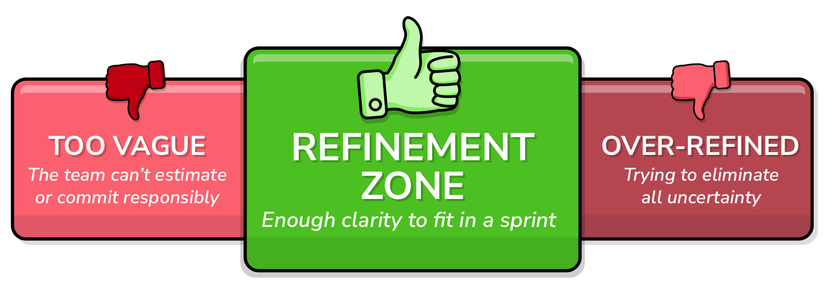
Refine to Confidence, Not Certainty: Too little refinement creates chaos. Too much refinement creates waste. Stop refining when the team can responsibly commit to finishing the work in a sprint.
The goal is not to refine until the work is perfectly understood.
The goal is to refine until the work is achievable.
A Simple Rule of Thumb
My rule of thumb is straightforward:
Stop refining when the team knows the item will fit in a sprint.
That does not mean a guarantee.
It means reasonable confidence.
If there’s an unresolved issue that could dramatically increase the size of the work, resolve it before bringing the item into the sprint.
If the remaining uncertainty is small and unlikely to derail the sprint, it’s acceptable to carry it into development.
A Real Example of “Sprint-Threatening Uncertainty”
I once worked with a team building a bioinformatics application that required intense 3D visualizations.
One backlog item depended on how much data the system would need to support in those visualizations.
If the data stayed under a certain threshold, the team already had a visualization package that could handle it. If the data exceeded that threshold, the work would become much larger and might require custom development.
The Product Owner didn’t know how much data needed to be supported.
That uncertainty mattered. It wasn’t a minor detail. It directly affected whether the story could be completed in a sprint.
So the team made the right call: they deferred the item. They didn’t bring it into the sprint until the Product Owner could answer the question.
That’s refinement.
Refinement isn’t about removing all uncertainty. It’s about removing the uncertainty that prevents you from making a responsible sprint commitment.
How to Tell If Product Backlog Refinement Is Working
There are several ways to tell whether refinement is healthy.
Sprint Goals Are Achieved About 80% of the Time
I don’t want a team achieving its sprint goal 100% of the time. That usually means they’re playing it safe.
But I also don’t want them missing constantly.
A healthy target is that the team achieves its sprint goal about 80% of the time.
If a team consistently misses sprint goals, one of the first places I look is backlog refinement.
The Backlog Has a “Clarity Gradient”
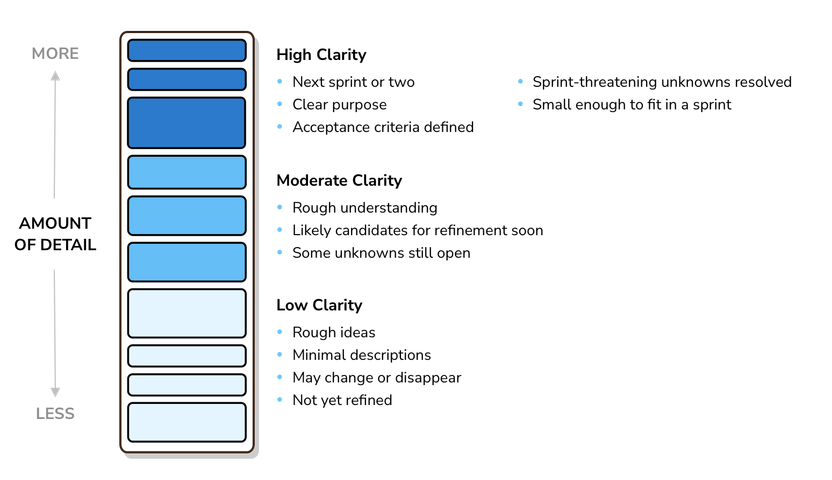
Refine the Top. Don’t Over-Refine the Bottom. A backlog isn’t supposed to be equally detailed from top to bottom. The next sprint or two should be clear enough to execute. Items further down should be vague enough to change.
A healthy backlog has more detail at the top and less detail as you move downward.
Upcoming work should have clarified assumptions and acceptance criteria.
Work further away should be less detailed and more flexible.
Over-detailing everything is wasted effort.
Less Work Carries Over
Strong refinement reduces mid-sprint surprises, which reduces unfinished work.
If carryover is common, refinement may be insufficient.
Try Story Critic on a Backlog Item
Paste in a user story, job story, or technical story (with or without acceptance criteria). The Story Critic gives you fast feedback on clarity, readiness, and backlog position.
Read more about the Story Critic and download a skill you can add to ChatGPT or Claude. Create a free MGS Essentials account for unlimited access to the Story Critic and other tools.
Common Product Backlog Refinement Mistakes
Most refinement problems stem from teams doing it at the wrong time, at the wrong level of detail, or with the wrong goal.
Here are the mistakes I see most often.
Trying to Eliminate All Uncertainty
Refine until the work fits in a sprint—not until every unknown is gone.
Refining Too Far in Advance
Priorities change. Stakeholders change their minds. Items become irrelevant.
Refining months ahead is often wasted effort.
Refining Too Late
If refinement happens right before Sprint Planning, there may not be time to resolve important questions.
Product Owners often need time to gather answers from stakeholders or make decisions. For more detail, see Rethink the Refinement Session: Less Time, Better Outcomes.
Turning Refinement Into a Design Session
Design discussions can be valuable. But refinement is not the place to finalize every design decision.
The test is simple:
Does this item clearly fit in a sprint?
If yes, refinement is complete. For more detail, see Rethink the Refinement Session: Less Time, Better Outcomes.
Involving Everyone Every Time
Further Reading
If you’d like a deeper look at why smaller refinement sessions often work better, see: Rethink the Refinement Session: Less Time, Better Outcomes
Many teams assume the entire team must attend every refinement session.
I don’t believe that’s necessary.
Refinement involves a trade-off between meeting cost and insight gained. You can often get most of the benefit with a subset of the team.
To avoid knowledge silos, don’t use the same subset every time. Rotate attendance.
And when you know you’ll be discussing a large, vague, high-uncertainty backlog item, involve everyone.
Refinement should be collaborative. But it should also be efficient.
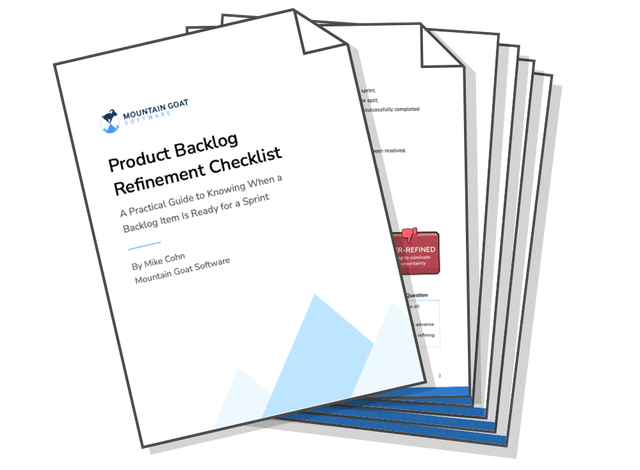
If you want a practical way to apply what you’ve read here, download The Product Backlog Refinement Checklist.
It includes:
- A “Will It Fit in a Sprint?” checklist
- A quick list of refinement anti-patterns
- Guidance on who should attend refinement
- A gotchas list template for avoiding repeat surprises
If you’ve ever left Sprint Planning thinking, “That took way too long,” this will help.
Who Should Attend Product Backlog Refinement?
There is no universal rule, but here are practical guidelines that work for most teams:
- Include enough cross-functional representation to uncover meaningful risks.
- Rotate attendance if not everyone joins each time.
- Include the whole team for high-uncertainty items.
- Ensure the Product Owner is prepared and engaged.
The goal is shared understanding—not maximum attendance.
How Often Should You Do Product Backlog Refinement?
Teams tend to approach refinement in one of two ways.
Continuous Refinement
Some teams keep the backlog “clean” all the time. They might:
- Refine briefly every week
- Clarify items informally during the sprint
- Maintain steady attention to upcoming work
Periodic Cleanup
Other teams let the backlog get a little messy and then refine in batches, perhaps every couple of sprints.
Both approaches can work.
What matters is that refinement happens often enough that Sprint Planning isn’t forced to do refinement’s job.
Personally, I lean toward continuous refinement. But batching can work if it’s disciplined.
Refinement Is a Form of Estimation
There is an implicit level of estimation happening during refinement.
When the team asks, “Will this fit in a sprint?” they are making a size judgment—even if they haven’t assigned story points yet.
Refinement and estimation are tightly connected.
Weak refinement leads to weak estimates.
Strong refinement improves confidence in forecasts.
And if a team believes estimation is pointless, refinement is often the missing ingredient.
The Gotchas List: Capturing Organizational Learning
Teams often get surprised by the same types of issues repeatedly.
A simple way to reduce this is to maintain what I call a “gotchas list.”
A gotchas list is a short list of recurring issues that have previously disrupted sprints—things that are easy to forget and expensive to rediscover.
Example:
| Gotcha | Reminder |
|---|---|
| Reporting impact | Check reports for every feature change |
During refinement, the Scrum Master or coach can periodically remind the team of the list.
A gotchas list is a way of capturing team learning so you don’t keep paying for the same mistake.
One Simple Improvement to Try Next Week
If your team struggles with refinement, try this experiment:
Refine less.
During refinement, ask:
Do we know enough to believe this will fit in a sprint?
If the answer is yes, stop refining and move on.
If the answer is no, identify the biggest unknown and resolve it before bringing the item into the sprint.
Perfection is not required.
Confidence is.
Refinement should be collaborative. But it should also be efficient.
Most teams don’t struggle with refinement because they aren’t doing it.
They struggle because they’re doing it inefficiently—either too little or too much.
If you want a simple tool to make refinement more effective (and usually shorter), download The Product Backlog Refinement Checklist.
It includes:
- A “Stop When It Fits” decision guide
- A refinement agenda you can use immediately
- A list of the most common refinement mistakes
- A gotchas list template to prevent repeat surprises
Use it with your team and see if Sprint Planning gets easier within a sprint or two.
And if you’d like help improving refinement across multiple teams, this is one of the topics we cover in our private workshops using your real backlog items.
Why Leaders Should Care About Product Backlog Refinement
To leaders, refinement can sound like internal team hygiene.
It isn’t.
Think of it like repairing potholes in a road.
A road full of potholes slows traffic. Cars stop and swerve. Travel time becomes unpredictable.
Fix the potholes and everything moves faster.
Product backlog refinement smooths the backlog.
It reduces the number of times a team has to stop mid-sprint to get answers, split work, or re-plan. It improves throughput. It improves predictability.
Refinement is not just a Scrum activity.
It’s an investment in delivery flow.
FAQ
What is product backlog refinement?
Product backlog refinement is the ongoing work of making upcoming backlog items clear enough for useful decisions, estimation, and sprint planning.
Who should attend product backlog refinement?
Include the people needed for the decision or learning at hand. That often means the Product Owner and a few Developers, not necessarily the entire team every time.
How much refinement is enough?
Enough refinement means the team can select work confidently without trying to remove all uncertainty before the sprint begins.
Is refinement required in Scrum?
Scrum does not define a formal refinement event, but teams usually need refinement to keep product backlog items ready enough for planning and delivery.
What makes refinement too heavy?
Refinement becomes too heavy when teams try to design everything, involve everyone in every conversation, or refine work far earlier than the decision requires.
Closing Thoughts
Product backlog refinement is not about perfection.
It is about creating enough clarity to support responsible sprint commitments.
Refine until the work fits in a sprint.
Avoid over-refinement.
Avoid under-refinement.
Capture learning.
Be efficient.
When refinement is healthy, Sprint Planning becomes easier, sprint goals become more achievable, and teams spend less time being surprised.
And that’s what predictable delivery requires.
Last update: April 23rd, 2026

Writing the Product Backlog Just in Time and Just Enough
FeaturedKeep backlog detail just enough and just in time.

Backlog Refinement Workshop
FeaturedImprove refinement using real backlog items so planning is clearer and faster.
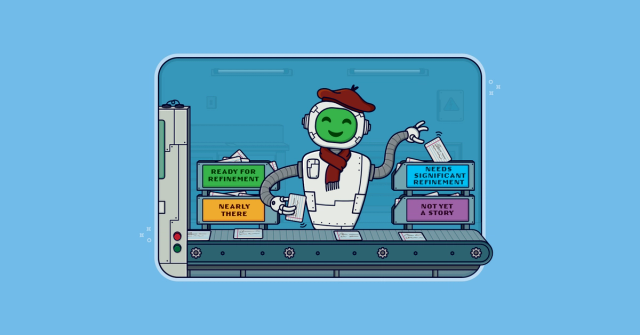
How the Story Critic AI Skill Helps Teams Write Better Backlog Items
FeaturedSee how AI coaching can help teams write clearer, smaller, more testable backlog items.

AI Changes What Makes a Product Backlog Valuable
FeaturedAI makes detailed backlog items and working software easier to produce. Learn why that favors more dynamic backlogs and makes early validation more important.
AI Can Write User Stories. But Should You Build Them?
See why polished AI-generated stories can still describe the wrong product—and how teams keep product judgment in the loop.

AI Can Write Backlog Items. It Can’t Create Shared Understanding
AI can generate polished user stories and acceptance criteria in seconds. Learn how to use it without skipping product judgment, user evidence, or team conversations.
What Happens When During a Sprint
Succeeding with Scrum is easier when you know when and why to conduct each of the Scrum events during the sprint.

Product Backlog Refinement
Learn about product backlog refinement: how, when, and why the agile team and product owner refine the product backlog in Scrum.
Does Scrum Have Too Many Meetings?
Are teams complaining about Scrum meetings? Learn why that happens, and how to fix it.

Backlog Story Improvement
Improve backlog quality, story splitting, refinement, and the flow of work from idea to delivery.
Rethink the Refinement Session: Less Time, Better Outcomes
Learn how to make your backlog refinement faster, sharper, and more effective.

How to Use AI for Product Discovery and Writing Better User Stories
Use AI to support product discovery, user interviews, and writing better user stories.
Multiple Levels of Done
Define done at more than one level so expectations stay clear from story to release.

3 Ways to Help Agile Teams Plan Despite Uncertainty
We might not like ambiguity, but it’s a fact of life. Find out how to plan with uncertainty in mind.
Why Scrum Isn’t Working Even Though You’re Doing Scrum
Story splitting helps teams turn large user stories into smaller, valuable pieces they can finish within a sprint without turning them into tasks.
What Does a Product Owner Do, When, and Why?
Clarify what product owners do before work starts, during planning, and throughout each sprint.

Four Reasons Agile Teams Estimate Product Backlog Items
Estimating product backlog items provides benefits beyond predicting when a project will be finished.
Product Backlog Refinement Checklist
Bring this practical checklist to your next refinement session to decide whether backlog items are clear and ready enough for a sprint. Download The Product Backlog Refinement Checklist and use it in your next…

AI Doesn’t Eliminate Agile Teams — It Increases the Need for Great Ones
Discover how AI is reshaping agile teams, why collaboration matters more than ever, and what leaders must do.

We Tried Agile and It Didn’t Work
“We tried agile and it didn’t work” is one of the most revealing things a leader can hear.

Why Agile Teams Should Estimate at Two Different Levels
It’s important for most agile teams to estimate both their product and sprint backlogs. But why?

Why Your Product Backlog Should Look Like an Iceberg
Shape the backlog so near-term items are detailed and lower-priority work stays lighter.

Why I Don’t Emphasize Sprint Goals
Sprint goals are considered a mandatory part of Scrum. Here’s why I disagree.

Story Critic
Story Critic is a free AI coach for improving backlog items without turning them into miniature specifications. It helps developers, testers, analysts, designers, and product owners make user stories, job stories,…

Mastering User Stories
A one-day course where your team improves real backlog items while learning how to write, split, and refine better stories.

Backlogs
Learn how to shape, prioritize, refine, and size product and sprint backlogs so teams can focus on valuable work that is ready at the right time.

Story Writing Workshop
Improve real backlog items in a facilitated workshop so teams can practice user stories with work they actually need to deliver.