

Sometimes teams write a user story for this activity such as: "As a user, I want at least 15 bugs fixed" or, "As a user, I want you to spend about 50 hours this sprint fixing bugs so that the application becomes gradually more high quality." Even a team that doesn't explicitly write such a user story will usually include a row on its taskboard to make the agile defects and bug fixing visible, and to track it.
In these situations, a common question is whether the team should assign some number of story points to the work of fixing these legacy bugs. If the team does not assign a story point value to this work, velocity will show the amount of "forward progress" the team is making each sprint. This has the advantage of making visible that the team is going more slowly through the work than it could if these legacy bugs had been fixed when originally found. On the other hand, if the team does assign points to the agile defect bug-fixing effort, velocity comes to represent the team's true capacity to accomplish work.
When migrating a product from a traditional approach to an agile one, teams commonly bring along a large database of agile defects. These are the result of an inadequate focus on continuous high quality. Shortly into their agile initiative, many teams (and their product owners) decide to aggressively work through the bug backlog. A common approach for doing so is to plan to fix X bugs per sprint or spend Y hours on bugs per sprint.
My usual recommendation is to assign points to bug fixing the agile defects. This really achieves the best of both worlds. We are able to see how much work the team is really able to accomplish, but also able to look at the historical data and see how much went into the bug-fixing story each sprint.
Knowing this can be helpful to a team and its product owner. For example, imagine a situation in which the product owner is considering suspending bug fixing for the next six sprints in order to add a valuable different feature into a release. If we know that the team's full historical average velocity was 25 but that 5 points went to bug fixing each sprint, we know that suspending bug fixing for the next six sprints will result in 30 (6*5) more points of new functionality.

Story Points
FeaturedStory points help agile teams estimate product backlog items by comparing one item with another. They are useful because teams rarely need perfect predictions.

What Are Agile Story Points?
FeaturedUnderstand what story points measure and why they are often misunderstood.

Should a Team Assign Work During Sprint Planning?
FeaturedSome teams assign all tasks upfront. Others don’t.

How Product Owners Can Evaluate Refactoring Work
Learn how product owners can evaluate refactoring when user-visible benefits are indirect.

Capacity-Driven Sprint Planning
Plan sprints around real team capacity instead of relying only on past velocity.

What Belongs In A Product Backlog
A product backlog contains the possible future work for a product. That work is often expressed as user stories.

Estimating
Build practical agile estimating skills with story points, planning poker, triangulation, velocity, and techniques for making useful forecasts without chasing false precision.

Why I Don't Use Story Points for Sprint Planning
I don't use story points for sprint planning because story points are a useful long-term measure. They are not useful in the short-term.

Know Exactly What Velocity Means to Your Scrum Team
Define velocity clearly so teams use it consistently.


Should You Use Zero-Point Estimates on Your Product Backlog?
Understand when a zero-point estimate is useful and when it hides real work.
Improving On Traditional Release Burndown Charts
Use release burndown charts to see progress and scope together.
Who Writes User Stories on Scrum Teams?
Learn who is responsible for writing user stories on a Scrum team, who can write user stories, and why it matters.
Product Backlog Refinement Checklist
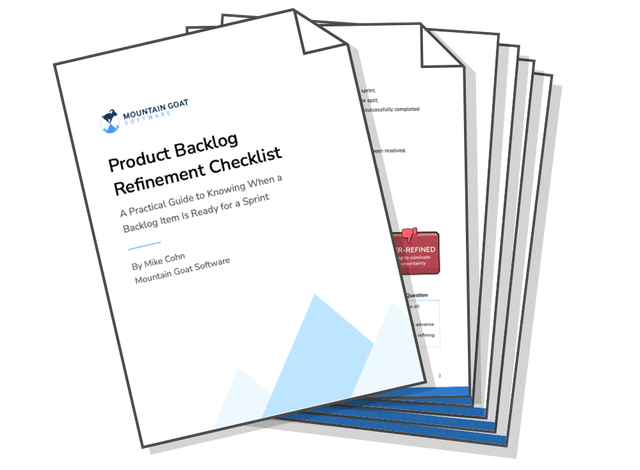
Bring this practical checklist to your next refinement session to decide whether backlog items are clear and ready enough for a sprint. Download The Product Backlog Refinement Checklist and use it in your next…

Plan Visualizer
The Plan Visualizer is a free agile forecasting tool for testing whether a target scope can be completed by a target deadline. It plots the plan against a low and high velocity estimate so teams and stakeholders can…

Velocity Range Calculator
Use this to calculate a velocity range from historical sprint data and support milestone forecasting.

Estimating & Planning
Improve estimates, forecasts, release planning, and conversations about scope, timing, and risk.

Accurate Agile Planning
Help teams create credible forecasts, plan under uncertainty, and make better decisions about scope, timing, risk, and tradeoffs.