

A story-writing workshop is a focused session for creating or improving a product backlog with the people who understand the product, users, and work.
It is especially useful when a team is starting something new, planning a major capability, repairing a messy backlog, or aligning around a significant objective.
Why Run a Story-Writing Workshop?
Teams often write stories in fragments.
A stakeholder sends an idea. A product owner turns it into a backlog item. A developer adds a technical note. A tester asks questions later. By the time the story reaches sprint planning, everyone has a slightly different picture.
A workshop brings the right people together earlier. The group creates shared understanding, identifies user roles, maps the work, writes candidate stories, and spots gaps before development begins.
The workshop should leave the team with a useful starting point that can be refined as the team learns.
Start with a Significant Objective
A workshop needs a focus.
The significant objective might be an MVP, a release goal, a quarterly objective, a product outcome, or a major user capability. It should be important enough to justify a workshop and specific enough to keep the group from mapping everything.
For example:
- Let new customers evaluate and buy the product without sales assistance.
- Help support agents resolve refund requests more quickly.
- Allow payroll specialists to identify missing approvals before payroll processing.
The objective tells the group what stories to look for and what to ignore for now.
Who Should Attend?
The product owner should attend. So should the people who will design, build, test, and support the work.
Depending on the topic, invite people such as:
- The product owner
- Developers, testers, designers, and analysts
- A Scrum Master or agile coach
- Stakeholders or subject matter experts
- Customer-facing staff
- Users or customer representatives
Keep the group large enough to include the knowledge needed and small enough to have a real conversation.
A workshop run by only the product owner may produce stories. A workshop with the team produces understanding.
Prepare Lightly but Intentionally
Good preparation helps the workshop move quickly.
Before the session, clarify the objective, collect relevant background, identify likely user roles, and decide whether a story map will be used. Bring examples, product data, customer feedback, constraints, sketches, or process notes that may help.
Do not prepare so much that the workshop becomes a presentation. The value is in the group's discovery and discussion.
A Practical Workshop Flow
A useful story-writing workshop often follows this flow:
- Review the significant objective.
- Identify users, user roles, or personas.
- Sketch the user journey or story map backbone.
- Add story ideas beneath the major steps.
- Discuss important rules, risks, and assumptions.
- Identify stories that are too large or unclear.
- Capture questions, decisions, and follow-up work.
- Decide what should be refined next.
Detailed splitting, acceptance criteria, and story cleanup can happen in follow-up sessions. The workshop should create shared understanding and a useful starting backlog, not finish every story.
The agenda should fit the situation. A small enhancement may need a short session. A new product area may need a longer workshop or multiple sessions.
Use Story Mapping to Organize the Work
Story mapping is often the best structure for a workshop.
The map helps the group see the user's path from left to right. It also gives people a place to put related stories, alternatives, exceptions, and details.
As the map grows, the team can see where the first useful version might be. They can also spot steps with too many stories, missing areas, unclear assumptions, or dependencies.
A flat list of stories can be sorted later. During the workshop, the map helps people think together.
Write Stories Collaboratively
The team does not need perfect story wording during the first pass.
Start by capturing useful story ideas. Then improve the ones that matter most. Clarify the user. Replace vague goals with specific outcomes. Add the reason when it helps. Identify large stories and stories that will need examples or acceptance criteria in follow-up refinement.
This keeps the workshop from turning into a grammar exercise.
A useful question is: "What conversation would this story need before we could bring it into a sprint?"
After the Workshop
A workshop creates raw material. The product owner and team still need to refine the backlog.
After the session:
- Remove duplicates.
- Group related items if needed.
- Clarify story wording.
- Split stories that remain too large.
- Add notes and acceptance criteria where helpful.
- Order the backlog.
- Identify follow-up questions and owners.
The product owner does not need to preserve every story generated during the workshop. Some ideas are useful only because they help the team discover better ones.
Common Workshop Problems
Too Broad a Scope
If the objective is too large, the workshop becomes unfocused. Narrow the objective and map the most important product area first.
Too Much Pre-Writing
If one person arrives with all the stories already written, the workshop becomes review rather than discovery. Bring context, not conclusions.
Too Many People
Large groups can be useful for input, but hard for writing. Consider smaller breakout groups or separate discovery and refinement sessions.
No Follow-Through
Stories created in a workshop need refinement, ordering, and ownership. Otherwise the workshop produces a large pile of backlog items that quickly becomes stale.
FAQ
When should we run a story-writing workshop?
Run one when the team needs to create or substantially improve a set of related stories. Common times include product start, release planning, major feature discovery, or backlog cleanup.
How long should a workshop take?
It depends on the objective. A focused capability may take a couple of hours. A larger product area may take a day or be split across sessions.
Should stakeholders attend?
Yes, when they bring knowledge the team needs. Keep the session structured so stakeholders contribute context without turning the workshop into a prioritization debate.
Should users or customers attend?
Often, yes. Direct user or customer input can improve the map and expose assumptions. When direct participation is not possible, use research, support data, interviews, or customer-facing staff.
Facilitation Tips
A story-writing workshop needs facilitation because the group will naturally drift toward solution debates, priority debates, and detailed design conversations.
Keep returning the group to the significant objective. When someone suggests a story, ask where it fits in the user journey and whether it helps achieve the objective. When someone raises a design detail, capture it if useful, but do not let it stop story discovery.
Use visible working agreements. For example, agree that rough story wording is acceptable during the first pass, that large stories will be split later, and that unresolved questions will be captured instead of debated endlessly.
Timebox difficult discussions. If a topic needs more research or a decision from someone outside the room, mark it as follow-up. Workshops lose energy when every unresolved issue becomes a meeting inside the meeting.
Finally, involve the team in improving the stories. Developers, testers, and designers often see missing scenarios, risky assumptions, or better splits earlier than stakeholders expect.
Signs the Workshop Was Worth It
A good workshop should leave the team with more than a pile of sticky notes.
Look for these outcomes:
- The team has a clearer shared objective.
- Important user roles or personas are visible.
- The group has a story map or organized set of candidate stories.
- Large stories have been identified for splitting.
- Near-term stories have enough detail to refine further.
- Open questions have owners.
- The product owner has better ordering options.
If the workshop creates too many stories, that is manageable. If it creates no shared understanding, the team will feel the cost later.

Story Writing Workshop
FeaturedImprove real backlog items in a facilitated workshop so teams can practice user stories with work they actually need to deliver.
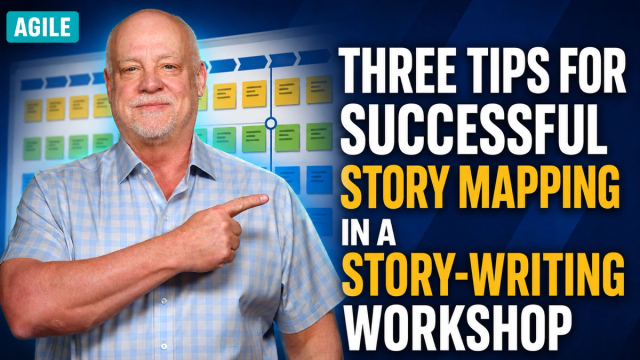
Three Tips for Successful Story Mapping in a Story-Writing Workshop
FeaturedExplore Three Tips for Successful Story Mapping in a Story-Writing Workshop in this Mountain Goat Software video.
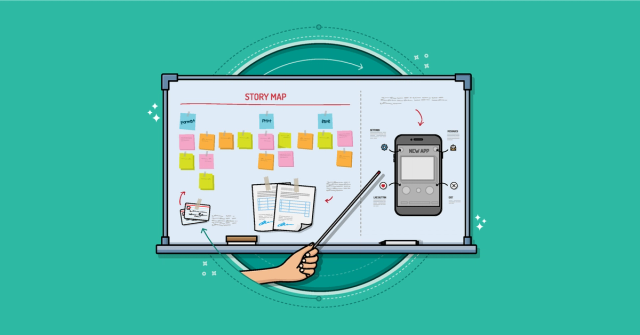
User Stories: How to Create Story Maps
FeaturedStory maps help to create a shared understanding of the product, visualize user needs, and elicit user story ideas. Discover how to create your own.
AI Can Write Backlog Items. It Can’t Create Shared Understanding
FeaturedAI can generate polished user stories and acceptance criteria in seconds. Learn how to use it without skipping product judgment, user evidence, or team conversations.
4 Reasons to Include Developers in Story Writing
See why developers should help write user stories before work reaches the sprint.
What Does a Product Owner Do, When, and Why?
Clarify what product owners do before work starts, during planning, and throughout each sprint.
Writing the Product Backlog Just in Time and Just Enough
Keep backlog detail just enough and just in time.
Story-Writing Workshop Guide
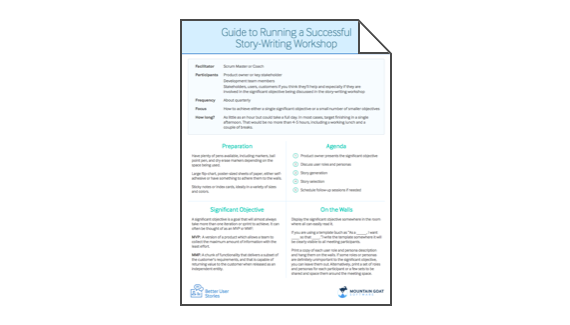
Plan and facilitate a collaborative story-writing workshop that involves developers and produces stronger backlog items. A story-writing workshop is one of the best ways to involve developers in story writing.

Mastering User Stories
A one-day course where your team improves real backlog items while learning how to write, split, and refine better stories.

Backlog Refinement Workshop
Improve refinement using real backlog items so planning is clearer and faster.
How to Use AI for Product Discovery and Writing Better User Stories
Use AI to support product discovery, user interviews, and writing better user stories.

How Detailed Should a User Story Be?
Capturing too much or too little detail in a user story causes problems. Here's how to get it right, iteratively.
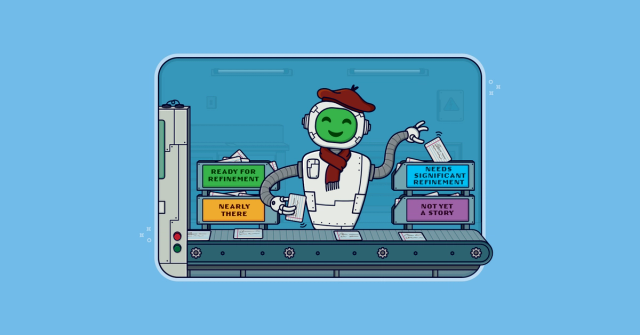
How the Story Critic AI Skill Helps Teams Write Better Backlog Items
See how AI coaching can help teams write clearer, smaller, more testable backlog items.
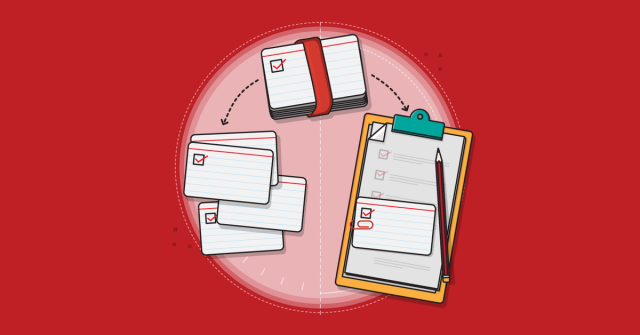
The Two Ways to Add Detail to User Stories
User stories can be deliberately vague at first but detail needs to be added eventually. There are two ways to do that.

3 Ways to Help Agile Teams Plan Despite Uncertainty
We might not like ambiguity, but it’s a fact of life. Find out how to plan with uncertainty in mind.
2 Times to Play Planning Poker and 1 Time Not To
I recommend using Planning Poker on product backlog items rather than on the tasks that make up a sprint backlog.
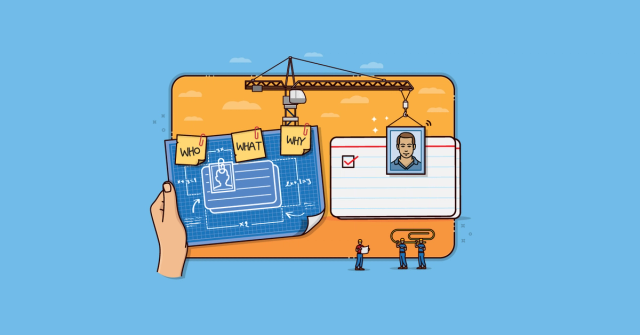
User Story Template: What It Is and Why It Works So Well
Understand why the three-part user story template works and where it falls short.
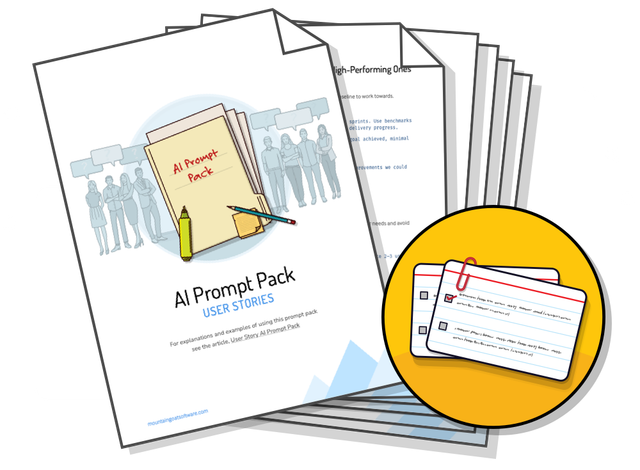
AI Prompts for Writing Better User Stories
Create INVEST-ready stories, fast. This prompt pack captures Mike Cohn’s process for writing and refining user stories and makes it reusable with AI.

Write Better User Stories in Less Time With Less Aggravation
In this webinar, Mike Cohn shares three practical techniques for writing better user stories with less time and frustration. He explains how periodic story-writing workshops help teams look beyond the next sprint,…
Focusing Where We Can Have the Most Impact
Mountain Goat Software is shifting its training and coaching focus to private client work, where teams and leaders can apply agile to their real challenges.
Short Answers to Your Big Questions about User Stories
Get quick answers to common questions about user stories and acceptance criteria.

Backlog Story Improvement
Improve backlog quality, story splitting, refinement, and the flow of work from idea to delivery.

Why Agile Teams Should Estimate at Two Different Levels
It’s important for most agile teams to estimate both their product and sprint backlogs. But why?

Story Critic
Story Critic is a free AI coach for improving backlog items without turning them into miniature specifications. It helps developers, testers, analysts, designers, and product owners make user stories, job stories,…