
As described in [Agile Estimating and Planning](/books/agile-estimating-and-planning), I'm a huge fan of using story points for estimating the [product backlog](/agile/scrum/artifacts/product-backlog). However, I also recommend estimating the [sprint backlog](/agile/scrum/artifacts/sprint-backlog) in hours rather than in points. Why this seeming contradiction? I've [previously blogged on the reasons why](/agile/to-re-estimate-or-not-that-is-the-question) I recommend using different estimation units (points and hours) for the different backlogs. But I'm often asked this related question I want to address here:
I'm curious why you aren't using story points to do your sprint planning. I thought that the point of measuring story point velocity was partly to determine how much we can take on (or commit to) in a sprint. Do you only use story points for longer-term planning (e.g. release planning)?
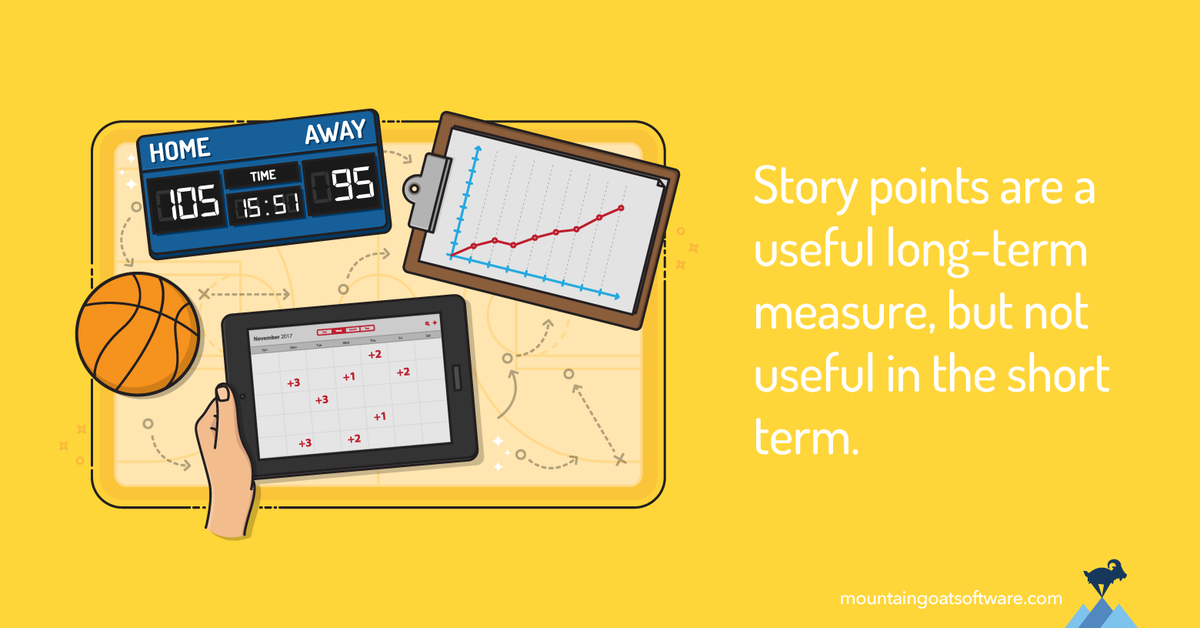
I don't use story points for sprint planning because story points are a useful long-term measure. They are not useful in the short-term. It would be appropriate for a team to say "We have an average velocity of 20 story points and we have 6 sprints left; therefore we will finish about 120 points in those six sprints." It would be inappropriate for a team to say, "We have an average velocity of 20 story points so we will finish in the next sprint." It doesn't work that way. Suppose a basketball team is in the middle of their season. They've scored an average of 98 points per game through the 41 games thus far. It would be appropriate for them to say "We will probably average 98 points per game the rest of the season." But they should not say before any one game, "Our average is 98 therefore we will score 98 tonight." This is why I say velocity is a useful long-term predictor but is not a useful short-term predictor.
Velocity will bounce around from sprint to sprint. That's why I want teams to plan their sprints by looking at the product backlog, selecting the one most important thing they could do, breaking that product backlog item / user story into tasks and estimating the tasks, asking themselves if they can commit to delivering the product backlog item, and then repeating until they are full. No discussion of story points. No discussion of velocity. It's just about commitment and we decide how much we can commit to by breaking product backlog items into tasks and estimating each. This is called capacity-driven sprint planning.
When a team finishes planning a sprint in this way it is indeed likely that the number of story points they have unknowingly committed to should be close to their long-term average but it will vary some. It will also be true that a team will commit to approximately the same number of hours from one sprint to the next. I use the term capacity to refer to this number of hours because velocity is reserved for referring to measuring the amount of work planned or completed as given in the units used to estimate the product backlog (which I recommend be done using story points).

Velocity-Driven Sprint Planning
FeaturedPlan sprints using velocity while understanding its limits.
Why I Prefer Capacity-Driven Sprint Planning
FeaturedThe problem with velocity-driven sprint planning is that velocity is simply too variable to be useful in the short term.

Capacity-Driven Sprint Planning
FeaturedPlan sprints around real team capacity instead of relying only on past velocity.

When Should We Estimate the Product Backlog
Estimate backlog items at the right time and level of detail.

Estimating & Planning
Improve estimates, forecasts, release planning, and conversations about scope, timing, and risk.

Story Points
Story points help agile teams estimate product backlog items by comparing one item with another. They are useful because teams rarely need perfect predictions.

Estimating
Build practical agile estimating skills with story points, planning poker, triangulation, velocity, and techniques for making useful forecasts without chasing false precision.

Don’t Estimate the Sprint Backlog Using Task Points
Some teams like story points so much, they invent task points and use those for sprint planning. Bad idea.

Should You Re-Estimate Unfinished Stories?
We avoid having unfinished work at the end of a sprint, but it sometimes happens. Here’s what to do.

What Are Agile Story Points?
Understand what story points measure and why they are often misunderstood.

Four Reasons Agile Teams Estimate Product Backlog Items
Estimating product backlog items provides benefits beyond predicting when a project will be finished.

Why Agile Teams Should Estimate at Two Different Levels
It’s important for most agile teams to estimate both their product and sprint backlogs. But why?

Don’t Equate Story Points to Hours
Story points are about time, specifically effort. But that does not mean you should say, “One story point = eight hours.

Should a Team Assign Work During Sprint Planning?
Some teams assign all tasks upfront. Others don’t.

Do Agile Teams Include Semi-Finished Work in Velocity?
Should teams receive partial credit on nearly finished stories when calculating their sprint velocity? Find out in this video blog from Mike Cohn.
Three Approaches to Estimating the Impact of Holidays and Time Off on Velocity
How to adjust velocity for holidays and time off.

Plan Visualizer
The Plan Visualizer is a free agile forecasting tool for testing whether a target scope can be completed by a target deadline. It plots the plan against a low and high velocity estimate so teams and stakeholders can…

Velocity Range Calculator
Use this to calculate a velocity range from historical sprint data and support milestone forecasting.

Accurate Agile Planning
Help teams create credible forecasts, plan under uncertainty, and make better decisions about scope, timing, risk, and tradeoffs.