
Everyone today seems eager to talk about how AI is accelerating software development. Teams are shipping faster. Individuals are more productive. Entire backlogs can be written in minutes. Estimates are a click away. Code that once took days now materializes in minutes. With all this newfound speed, it’s understandable that teams and leaders start asking whether they still need the same kinds of collaboration—or even the same kinds of teams.
Yet hidden underneath all that enthusiasm is a risk that hasn’t received enough attention. In fact, I would argue it is the risk that agile leaders should be paying the closest attention to.
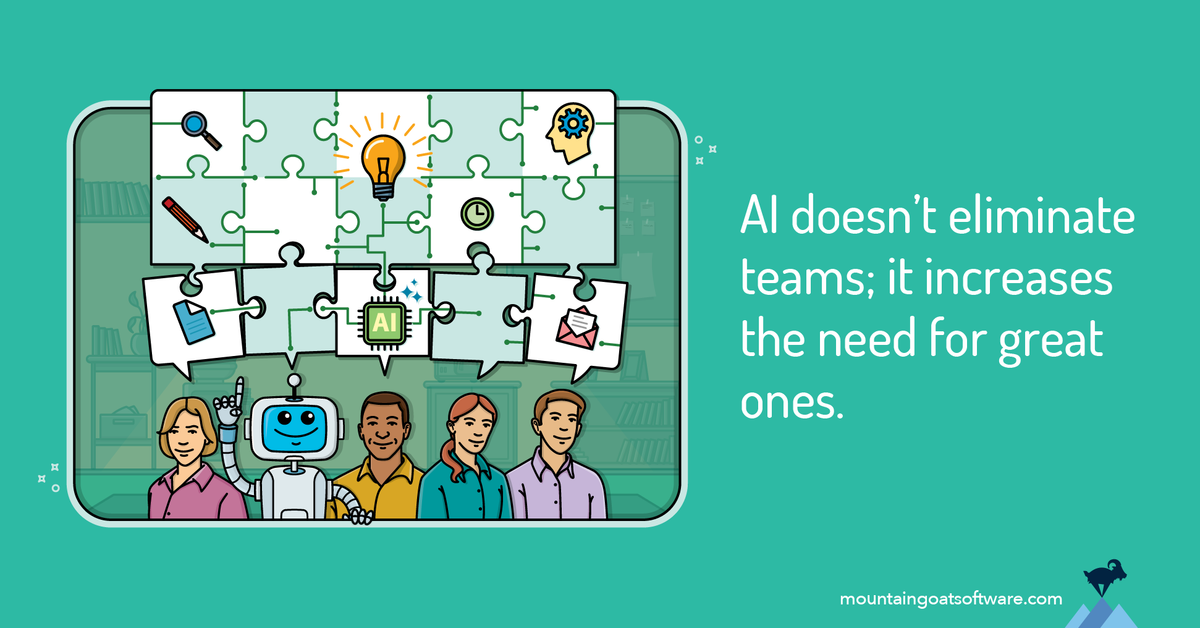
AI doesn’t eliminate teams; it increases the need for great ones.
The faster a team moves, the more collaboration it requires. The more productive individual contributors become, the more their work needs to be coordinated. And the more powerful AI becomes as a tool, the more dangerous it is when someone uses it in isolation. Put simply, AI amplifies everything—including misalignment.
Unfortunately, many teams are responding to AI by collaborating less. And that is where things begin to fall apart.
The Drift Away from Collaboration
Over the last few years, I’ve watched teams adopt AI tools in ways that unintentionally reduce communication. Developers can now accomplish huge amounts of work on their own. Product Owners can use AI to generate and split backlog items or even prioritize whole roadmaps. Teams start to believe they no longer need to talk as often because the tooling is doing so much of the work.
The theory goes: if AI can generate stories, code, and tests, perhaps the team can get by with fewer discussions.
The reality is very different.
I’ve seen teams that, excited by AI’s efficiency, quietly slip into working as a collection of individuals rather than as a cohesive unit. They may hold the same meetings, but the communication within those meetings becomes thin and surface-level. Outside the meetings, collaboration dwindles even further.
Example: a Team Moves Fast with AI, but Stops Talking
Consider one team that dramatically accelerated development because AI allowed it to refine and build features faster than ever. Impressed with the speed, they assumed their longstanding collaboration habits were no longer necessary. They talked less. They shared less. They coordinated less. And predictably, they began building a series of features that didn’t integrate well and didn’t match stakeholder expectations. They had increased their output but degraded their outcomes.
Their problem wasn’t AI.
Their problem was collaboration.
And AI simply magnified it.
How AI Is Transforming Roles—and Why That Matters
AI is not just speeding up development. It’s reshaping what the key roles inside agile teams actually do. These changes are significant, and understanding them helps us understand why collaboration remains so important.
Product Owners in the Age of AI: Supported, but at Risk of Over-Reliance
Product Owners may be the biggest beneficiaries of AI in the short term. AI can help them write backlog items, generate acceptance criteria, analyze customer sentiment, summarize research, and even propose priorities. For a role that has always struggled with having enough time to do the job, this is a welcome change.
But with that support comes temptation. It becomes too easy to delegate too much thinking to an AI. A Product Owner who lets AI drive backlog prioritization or roadmap decisions risks drifting away from customer needs, business realities, and strategic intent. AI can assist, but it cannot own core decisions such as product vision, market positioning, customer segmentation, or business models.
AI is a powerful assistant but a poor navigator.
I’ve seen Product Owners who let the AI do most of the heavy lifting only to discover later that the product had wandered off course. It’s an example of how AI can be a powerful assistant but a poor navigator.
Scrum Masters: Moving from Framework Guardians to Collaboration Coaches
For years, I’ve believed the Scrum Master role would inevitably shift as teams become more experienced. As a team becomes proficient with Scrum, team members absorb some of the responsibilities of a Scrum Master.
AI is accelerating that shift. The future Scrum Master is less of a process guardian and more of a human dynamics expert. They will likely work across multiple teams, operate part-time on any single one, and spend far less energy worrying about prescriptive frameworks.
Instead, they will focus on helping people work well together. Asking tough questions, facilitating constructive disagreements, and guiding the team through difficult decisions—these human-centric skills will define the role. Scrum Masters and agile coaches who cling to checklists and frameworks will become less effective. Those who cultivate emotional intelligence, facilitation skills, and the ability to coach collaboration will become essential.
I’ve seen Scrum Masters who remain overly focused on rituals and mechanics while their teams quietly slide into dysfunctional communication patterns. In an AI-driven world, that approach simply won’t work.
Developers: More Productive Than Ever
Developers have also experienced extraordinary leaps in productivity. AI helps them generate code, uncover bugs, explore architectural patterns, and write tests. This enables them to accomplish far more in less time. And with that increased capacity comes a shift in team design. Many products that previously required teams of eight might now effectively be built by teams of four or five.
This shift also changes how teams think about specialization. We will still need world-class experts for highly specialized problems, but many teams will rely on strong generalists who possess broad skills and deep AI fluency. It also means that developers—moving faster than ever—must communicate more frequently to avoid stepping on each other’s work.
AI accelerates their capabilities. Human alignment ensures those capabilities don’t create chaos.
The Future of Agile Teams: Smaller, More Fluid, and More Global
All of these changes point toward a future where agile teams look different than they did even a few years ago. I expect teams to become smaller and more fluid. In many organizations, “team membership” will include a stable core supplemented by temporary specialists who join for a few weeks or months to work on highly complex tasks before moving on.
We will also continue to see more distributed agile teams. The “work from anywhere” movement has only strengthened, and AI will make collaboration across time zones easier.
Yet despite these changes, the definition of a team should remain simple: a team is a group of identifiable people pursuing a shared goal. That definition still holds, even when membership becomes more fluid.
As AI lowers the cost of experimentation, teams will attempt more ideas, pursue more niche products, and pivot more quickly. This makes leadership more—not less—important. Leaders must provide direction, so experimentation does not devolve into chaos. They must set strategic intent, define boundaries, and articulate a North Star that teams can use as an anchor.
Essential Collaboration Practices Every AI-Enabled Agile Team Must Protect
Since AI accelerates work, the practices that hold teams together become even more essential.
Sprint Reviews Are Now Critical Alignment Moments
The Sprint Review is one of them. As AI speeds up delivery, ensuring alignment between what the team builds and what stakeholders expect becomes absolutely critical. Only through real human feedback—and the interpretation of that feedback—can teams ensure that AI-accelerated work remains on target.
Backlog Refinement Needs Human Judgment, Even When AI Assists
Backlog refinement is another practice that must remain human-led. AI can draft backlog items or propose ways to split stories, but only humans can decide if those items contain the appropriate amount of detail, whether the intent is right, and whether each aligns with the product vision.
Daily Communication Becomes More Important, Not Less
Daily communication becomes essential as teams move faster. That communication doesn’t need to be in a formal meeting—many teams will choose asynchronous check-ins rather than a traditional daily scrum—but the keys are frequency and consistency. When a team can build features in hours, they need to talk about what they’re doing more often, not less.
Iteration Planning Ensures Shared Understanding in a High-Speed World
Iteration planning is similarly indispensable. Even if AI assists in forecasting, the team must still align on intent and understand how their work fits together. Planning keeps the team grounded in shared understanding.
The common thread is simple:
AI accelerates work; collaboration prevents accelerated mistakes.
Teams that reduce collaboration as AI usage increases will eventually undermine the very speed they're trying to gain.
How Leaders Can Evaluate Whether AI is Helping or Hurting Their Teams
Leaders often ask how they’ll know whether AI is helping or hurting their teams. The answer doesn’t require a dashboard full of metrics.
Are team members communicating more frequently than they did before AI?
If communication is decreasing, collaboration is weakening—and teams are heading into danger.
The faster the team moves, the more essential communication becomes.
What Agile Leaders Should Measure (and What They Should Stop Measuring)
AI does not fundamentally change the metrics that matter. Time to value still matters. The speed at which teams learn and adapt still matters. Customer outcomes still matter.
What leaders should avoid is the temptation to find a single productivity metric that magically reveals team performance. AI won’t create that metric. It isn’t coming.
Leaders should instead evaluate how quickly their teams can experiment, learn, adapt, and deliver results in alignment with customer needs.
Update Agile Principles for the AI Era
One of the original Agile Manifesto principles is “responding to change over following a plan.” In an age where AI makes experimentation incredibly cheap, I would take that a step further. Today’s agile teams shouldn’t merely respond to change—they should create it.
AI gives teams the tools to explore possibilities proactively, not reactively. It allows them to test ideas quickly, pivot when necessary, and discover value faster than ever. But that only works when collaboration and alignment remain strong.
A Warning—and a Call to Action
If leaders misunderstand AI’s role, they may believe collaboration is optional or that teams don’t need to talk as much. They may assume AI can take over decision-making or that agile roles matter less.
The result will be teams that drift apart, lose alignment, and make faster—but worse—decisions. The real danger of AI is not the technology itself but how teams behave when they believe it can replace the human elements of teamwork.
And so, the call to action is clear:
-
Invest in human skills.
-
Strengthen collaboration.
-
Protect agile practices that make teams effective.
-
Support Scrum Masters as they evolve into true collaboration coaches.
-
Help Product Owners retain ownership of vision and strategy.
-
Use AI as a partner, not a replacement for teamwork.
AI makes individuals faster. Only teams make products great.

AI Can Write Backlog Items. It Can’t Create Shared Understanding
FeaturedAI can generate polished user stories and acceptance criteria in seconds. Learn how to use it without skipping product judgment, user evidence, or team conversations.

Five Story-Splitting Mistakes and How to Stop Making Them
FeaturedThere are plenty of mistakes a team can make when splitting user stories. Here are five of the most common.

Product Backlog
FeaturedA product backlog is a prioritized list of possible future work for a product. It helps the Product Owner and team decide what to build, fix, learn, or improve next.

A Leader’s Guide to Agile
FeaturedLearn the ten things agile teams need their leaders to understand, and how your actions can help them succeed. Get Mike Cohn’s free 91-page guide to the ten things agile teams most need their leaders to know.
AI Changes What Makes a Product Backlog Valuable
FeaturedAI makes detailed backlog items and working software easier to produce. Learn why that favors more dynamic backlogs and makes early validation more important.

Developers
Be a Great Product Owner: Six Things Teams and Scrum Masters Need
See what teams and Scrum Masters need most from a product owner to make delivery smoother.

Nine Questions Scrum Masters and Product Owners Should Be Asking
Use better questions to improve collaboration, decision-making, and team ownership.
Does Scrum Have Too Many Meetings?
Are teams complaining about Scrum meetings? Learn why that happens, and how to fix it.
What Does a Product Owner Do, When, and Why?
Clarify what product owners do before work starts, during planning, and throughout each sprint.

How to Get Teams Aligned on What It Means to Be Agile
Align leaders, teams, and stakeholders around what agile really means.

How to Estimate Story Points With Multiple Teams
Establishing a common baseline allows multiple teams to estimate consistently with story points.

The Sprint Goal: What It Is and How It Can Help
Sprint goals are something every Scrum team should try to create. Learn what sprint goals are and what a good sprint goal looks like.
Agile Teamwork
Learn how agile teams share responsibility, reduce handoffs, and finish valuable work together.

3 Ways to Help Agile Teams Plan Despite Uncertainty
We might not like ambiguity, but it’s a fact of life. Find out how to plan with uncertainty in mind.
Why you should consider stopping sprint reviews
For many teams, the sprint review has run its course and it’s time to stop doing them. Blasphemy?
What Are Agile Story Points?
Understand what story points measure and why they are often misunderstood.

Why Agile Teams Should Estimate at Two Different Levels
It’s important for most agile teams to estimate both their product and sprint backlogs. But why?

Product Backlog Refinement
Learn about product backlog refinement: how, when, and why the agile team and product owner refine the product backlog in Scrum.

Your Team Won’t Think of Everything in Sprint Planning Meetings. And That’s OK.
Your team is probably spending too much time in sprint planning meetings. Here’s how to spend less time but plan better.

What Product Owners Do & 7 Mistakes to Avoid
Use seven common product owner mistakes to spot where ownership, prioritization, or collaboration may be breaking down.

Why Teams Matter More Than Ever for Innovation
See why collaboration and shared purpose matter for innovation.