
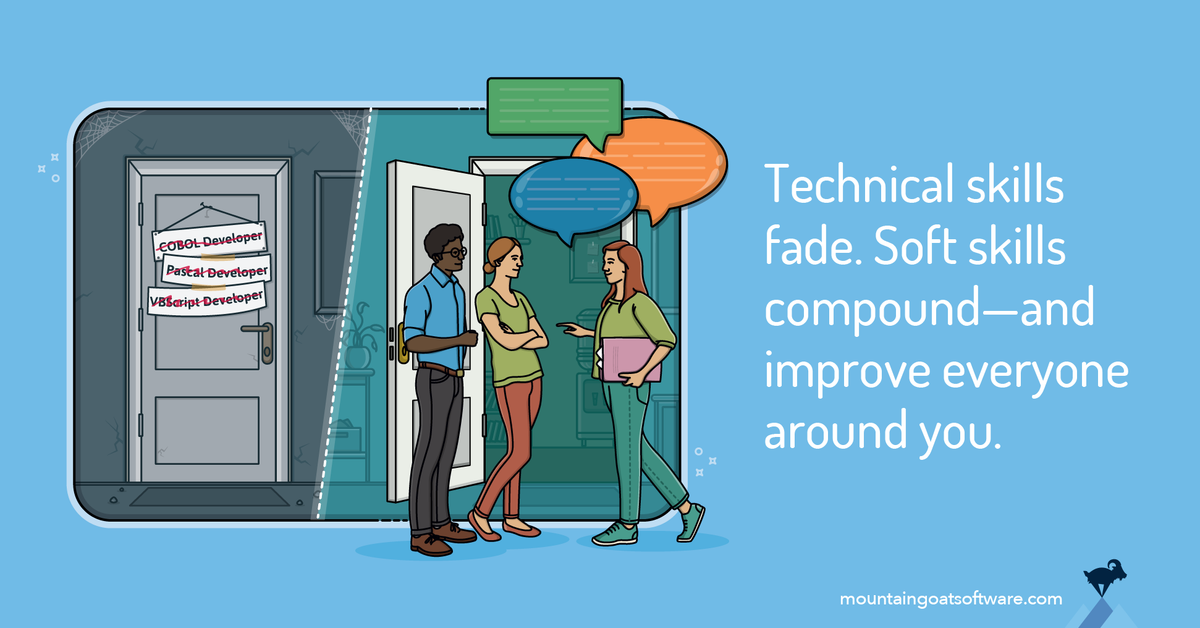
Anyone who has worked in product development for more than a few years has seen the same pattern repeat itself. Today’s essential technical skills gradually—or sometimes abruptly—become obsolete. Tools change. Frameworks fall out of favor. Architectures that once seemed modern begin to look dated.
This isn’t new, but it is accelerating. The half-life of technical skills keeps shrinking. In the 1980s, it took ten years for half of what you knew to become outdated. Today, it is four years, and will soon fall below two years according to a Stanford professor.
This reality raises an important question for leaders:
Where does investment in people have the greatest long-term impact?
Technical skills are necessary. But they are rarely durable. Soft skills, by contrast, tend to last—and even strengthen—over time.
The Short Half-Life of Technical Skills in Product Development
When someone learns a new programming language, framework, or tool, that skill has an expiration date. It may be valuable for a while, but eventually it will need to be replaced. That’s simply the nature of technology.
Soft skills behave differently. When someone learns how to collaborate effectively, make better decisions, facilitate discussions, or lead others, those skills don’t fade. Instead, they become part of how that person works.
Learning how to learn is a good example. Once someone develops that capability, it stays with them. The same is true for decision-making, leadership, and collaboration. These skills can continue to improve, but they don’t become irrelevant. Over the life of a team—or a career—that difference matters.
Why Soft Skills Matter More Than Ever on Product Teams
I once observed a meeting where a programmer was demonstrating new functionality to a group of nurses. During the demo, he showed text on the screen suggesting that a fussy newborn should be given Saltine crackers—clearly clinically inappropriate.
The programmer tried to explain that it was just placeholder text. The real point, he said, was that the system would eventually provide guidance to nurses. The specific wording didn’t matter.
To the nurses, it mattered a great deal.
Their professional identity is grounded in the principle of “do no harm.” What they saw on the screen violated that principle. They couldn’t get past it and were ready to escalate the issue and cancel the project entirely.
What saved the project wasn’t a technical correction. It was the project manager’s soft skills. He calmed the situation, acknowledged the nurses’ concerns, explained what had happened, and persuaded them to return a week later for a revised demonstration.
The real failure wasn’t technical. It was a failure of empathy. Had the programmer been able to put himself in the nurses’ position—or simply validated the example with one of them beforehand—the situation likely never would have occurred.
How Soft Skills Reduce Risk in Product Development
Product development is full of uncertainty. Teams work with evolving requirements, incomplete information, and users whose trust must be earned and maintained.
Soft skills reduce risk in these environments. Empathy helps teams understand users and stakeholders. Clear communication builds trust. Collaboration prevents small misunderstandings from becoming major setbacks.
When these skills are weak, teams often pay for it later through rework, damaged relationships, or lost opportunities. When they are strong, teams navigate uncertainty with far less friction.
Why Leaders Underestimate the ROI of Soft Skills
Many organizations underinvest in soft skills because the return is harder to measure. It’s relatively easy to send someone to a technical course and confirm they learned something new. It’s much harder to know whether someone has become a better collaborator or facilitator—until the team is under pressure.
There’s also a common assumption that people should already have these skills by the time they enter the workforce. As a result, gaps are ignored until they surface at the worst possible moments.
Ironically, those moments are when soft skills matter most.
Soft Skills Improve Team Performance, Not Just Individuals
When someone learns a new technical skill, the benefit often stays with that individual. But when someone learns to collaborate better, the entire team benefits.
Better collaboration improves communication, decision-making, and trust across the group. Everyone gets better—not just the person who attended the training. This multiplying effect is one of the most overlooked benefits of investing in soft skills.
Why Strong Soft Skills Matter Most Under Pressure
Some leaders believe improving soft skills can wait until things slow down. That may be, but you cannot wait until a crisis forces you to improve soft skills. A team under pressure is when their absence is most costly.
Teams with strong soft skills can have hard conversations when it matters. They can discuss options openly, disagree productively, and make better decisions under stress—because trust was built earlier.
Teams without those skills often shut down, avoid conflict, or default to the fastest solution rather than the best one.
Which Product Development Roles Need Strong Soft Skills Most
Everyone on a product development team benefits from strong soft skills, but some roles depend on them more heavily than others.
Scrum Masters rely on facilitation skills to help teams think clearly and work well together. Product Owners rely on leadership skills to align stakeholders, guide decision-making, and create shared understanding. Coaches and leaders shape the environment in which these skills are practiced daily.
When these roles are weak in soft skills, the entire team feels it.
Investing in Soft Skills Is the Most Durable Choice Leaders Can Make
This is why effective product development organizations don’t leave soft skills to chance. They treat them as capabilities that must be intentionally developed.
Technical skills will always matter—but they are temporary. Soft skills persist. They compound over time, strengthen entire teams, and show their value most clearly when the pressure is on.
Leaders who want teams that can adapt, collaborate, and make good decisions over the long term need to invest deliberately in these skills. That means treating collaboration, facilitation, and leadership as capabilities to be developed—not traits to be assumed.
If you want help building these skills in your Product Owners, Scrum Masters, and teams, Mountain Goat Software works with organizations to do exactly that. Through training, coaching, and hands-on learning, we help teams develop the soft skills that don’t fade—and that continue to pay off long after the latest technology has changed.

Agile Collaboration
FeaturedAgile collaboration is the way a team works together to finish valuable work, learn quickly, and adapt as it goes. It is more than good communication.
Why Soft Skills Matter More Than Technical Skills in Agile Teams
FeaturedAgile leaders often invest heavily in technical skills. But the skills that most improve team performance aren’t technical—they’re human. In this video, Mike Cohn explains why soft skills matter more than technical skills on Agile teams, and how leadership, collaboration, and decision-making shape long-term success.

Learn About Private Training
FeaturedExplore private training options for helping your teams build practical agile skills with courses tailored to your organization. Download this PDF to see how we can help you and your teams succeed with agile.

Agile Leadership
Agile leadership helps teams succeed by creating clarity, removing obstacles, and giving teams room to make good decisions close to the work. Great agile leaders set direction, create the right constraints, remove…
Be a Great Product Owner: Six Things Teams and Scrum Masters Need
See what teams and Scrum Masters need most from a product owner to make delivery smoother.
We Tried Agile and It Didn’t Work
“We tried agile and it didn’t work” is one of the most revealing things a leader can hear.

Should You Become a Product Owner?
Explore the skills, paths, and tradeoffs to consider before stepping into the product owner role.

Can the Product Owner and the Scrum Master Be the Same Person?
Discover what pirates have to teach us about why the ScrumMaster and product owner require different skills, and different people.

The Benefits of Feature Teams
Moving away from component teams is a difficult but necessary step for those who want to adopt an agile project management approach.
How to Get Teams Aligned on What It Means to Be Agile
Align leaders, teams, and stakeholders around what agile really means.

Does Scrum Have Too Many Meetings?
Are teams complaining about Scrum meetings? Learn why that happens, and how to fix it.

3 Ways to Ensure Agile Training Works to Transform Your Teams
The best agile training leads to real results. Learn how to ensure your investment pays off.
Six Agile Product Development Myths - Busted
Pervasive myths about agile get in the way of success. It’s time to bust six of those myths.
Does the Scrum Master Role Ever Go Away?
See how Scrum Master responsibilities change as teams become more self-sufficient.

Nine Questions Scrum Masters and Product Owners Should Be Asking
Use better questions to improve collaboration, decision-making, and team ownership.
AI Doesn’t Eliminate Agile Teams — It Increases the Need for Great Ones
Discover how AI is reshaping agile teams, why collaboration matters more than ever, and what leaders must do.
Self-Organizing Teams, their Benefits, and a Leader’s Role
Explore self-managing teams, including the role of leaders and outcomes of effective teamwork.
7 Questions to Determine if Being a Scrum Master Is Right for You
Thinking of a career as a Scrum Master? 7 questions to help you decide if it's the right job for you.
Self-Organizing Teams Are Not Put Together Randomly
There are things leaders can do that will influence how a team self organizes.