
I blogged recently on the question of whether a Scrum team can ever get so good that they no longer need a Scrum Master. In this post, I’ll address a closely related topic: Assuming that the role of Scrum Master does not go away, what is the career path for a Scrum Master?
In my experience, a Scrum Master’s career will usually evolve in one of four directions.
Multiple and More Challenging Teams
A typical career path for a Scrum Master will start with serving one team. The more that team masters agile teamwork principles and practices, the less time the Scrum Master has to spend with them, as the team is able to resolve most issues and take on responsibilities without prompting from the Scrum Master.
At that point, a good Scrum Master will seek additional challenges. Often the logical next step is to begin working with multiple teams concurrently or from working with more demanding teams or products.
When developing new Scrum Masters, I prefer to put the person in a position to most likely succeed. That will mean working with a team that has neither any difficult personalities nor unrealistic delivery expectations. But, to go from good to great, the Scrum Master will need to learn to work under more complex conditions.
This leads to the philosophy that success is often rewarded with additional challenges.
Mentor
A Scrum Master who has been successful in a variety of different contexts and teams, might choose to move into a role as a mentor to other Scrum Masters. This will especially be true and feasible as the Scrum Master gains skills and experience.
In many organizations, this role would be called an Agile Coach, with the most common job description being that an agile coach coaches Scrum Masters (and their teams).
Personally, I’m partial to such individuals mentoring rather than just coaching. Much of the benefit these experienced individuals provide comes through them offering guidance (“I suggest you do it this way”). Because of this, I think of these individuals as having become agile mentors.
This is an appropriate path for Scrum Masters who have learned that their true passion is the creative act of developing a product--largely independent of whatever the product may be. Some Scrum Masters enjoy the process of enabling creativity among development teams so much that it almost doesn’t matter what the product is.
Think about the radio DJ who just loves being a DJ and doesn’t care if he’s playing classic rock, the current top 40, or classical music.
The Scrum Master who loves the process more than the product is a likely candidate to follow a career path into becoming an agile coach or mentor.
The Scrum Master Becomes a Product Owner
Other Scrum Masters, however, learn that they love what their team is building more than the act of creating it. Those Scrum Masters become good candidates to become product owners.
I don’t want to imply that a product owner role is above the Scrum Master role in an organization. I consider the roles equivalent in a typical organizational hierarchy.
But some Scrum Masters learn that they care deeply about the thing being built rather than the process of building the thing. And from having worked with a team long enough, some of these Scrum Masters learn enough about the product, industry, users and such to become good product owners.
The Scrum Master Becomes a Manager
Scrum Masters are most assuredly not managers themselves. But through their Scrum Masters duties, Scrum Masters often work closely with those who are. And some will find that work intriguing.
Scrum Masters become adept at guiding teams without much authority to say, “Do it because I say so.” Because of this, many can move into management roles where they could demand compliance but because of what they’ve learned from being Scrum Masters, know it usually is best not to.
Especially if a Scrum Master has retained technical proficiency, moving into a role like QA director or development manager can be a fulfilling, logical step.
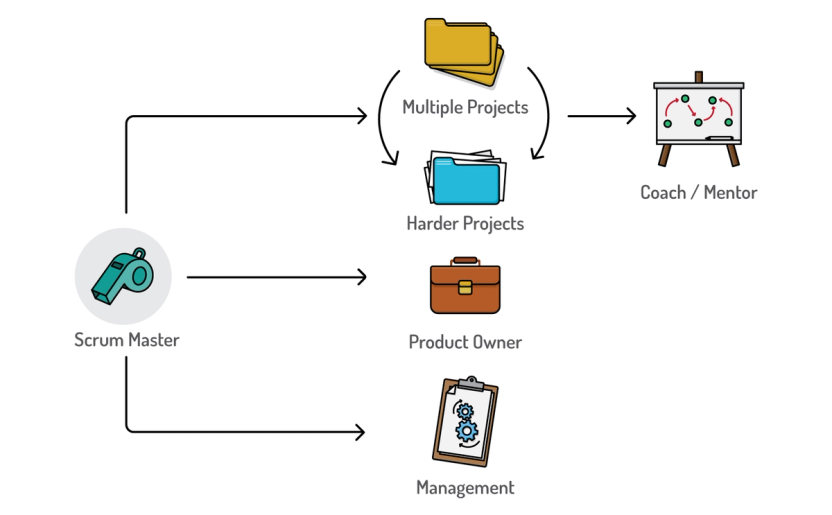
Scrum Masters often become coaches, mentors, product owners, managers or continue as Scrum Masters in more challenging situations.
A Scrum Master Has Options
There are many paths a Scrum Master may pursue. The skills learned in becoming a great Scrum Master will serve that person well whether they choose to become a mentor, manager, product owner or just work with more challenging teams.
In some ways, asking what is the career path for a Scrum Master is like asking what is the career path of a professional athlete.
Some professional athletes use their former careers as springboards to move into broadcasting. Others use the money they’ve made to start businesses--where I live in Colorado, car dealerships and pizza restaurants seem popular with retired athletes. Some athletes use their fame to enter politics.
Still other professional athletes would find the topic of a career path preposterous. They didn’t become athletes as a path to something else. Becoming a professional athlete was the goal itself.
And so it will be for many Scrum Masters. The role of Scrum Master can be an end itself. Doing it more and better can remain the goal. A professional athlete cannot perfect his or her sport. A Scrum Master cannot perfect that skill either. There is always room to improve. And so, for many Scrum Masters, there may be no career path other than the continuous improvement in themselves that Scrum Masters demand of their teams.
Should You Become a Product Owner?
FeaturedExplore the skills, paths, and tradeoffs to consider before stepping into the product owner role.

Nine Questions Scrum Masters and Product Owners Should Be Asking
FeaturedUse better questions to improve collaboration, decision-making, and team ownership.
Does the Scrum Master Role Ever Go Away?
FeaturedSee how Scrum Master responsibilities change as teams become more self-sufficient.
Situational Scrum Mastering
Learn how to adapt your Scrum Master leadership style to what the team needs with this free practical guide. Get a free copy of Situational Scrum Mastering: Leading an Agile Team
Can the Product Owner and the Scrum Master Be the Same Person?
Discover what pirates have to teach us about why the ScrumMaster and product owner require different skills, and different people.

New To Agile Or Scrum
Agile helps teams deliver value sooner, learn faster, and adapt when plans change. Use this guide to understand what agile is, how it differs from Scrum, when agile helps, and where to go next if you are just…
Scrum Master
Strengthen your Scrum Master practice with guidance on facilitation, team coaching, Scrum events, sustainable pace, common mistakes, and helping teams become more effective.

From Project Manager to Scrum Master -3 Tips for Making the Transition
What does a good project manager need to do to become a great Scrum Master?

Agile Collaboration
Agile collaboration is the way a team works together to finish valuable work, learn quickly, and adapt as it goes. It is more than good communication.
Why Soft Skills Outlast Technical Skills on Product Development Teams
Soft skills are the ones that can lead to lasting success.
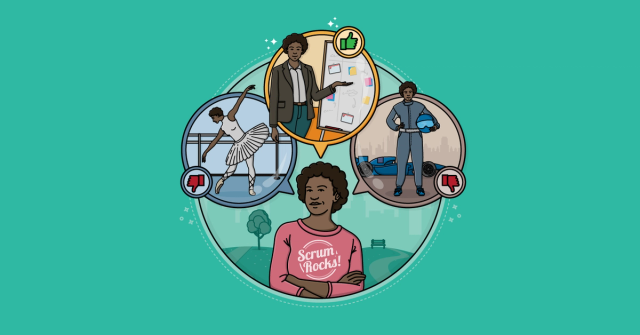
7 Questions to Determine if Being a Scrum Master Is Right for You
Thinking of a career as a Scrum Master? 7 questions to help you decide if it's the right job for you.
Be a Great Product Owner: Six Things Teams and Scrum Masters Need
See what teams and Scrum Masters need most from a product owner to make delivery smoother.
Three Questions to Determine If an Organization Is Agile
A lot of organizations claim to be agile. Here’s a quick way to see if they really are.
Agile Teamwork
Learn how agile teams share responsibility, reduce handoffs, and finish valuable work together.
8 Reasons Scrum Is Hard to Learn (but Worth It)
Transitioning to Scrum is worth it, but some aspects are challenging.
Six Things Your Team Wants from You as Their Scrum Master
See what teams most need from their Scrum Masters to thrive.
The Chivalrous Team Member
Recognize helpful behavior that strengthens collaboration and trust.

Effective Scrum Master
Help Scrum Masters improve facilitation, coaching, impediment removal, influence, and team ownership.
Advanced Certified ScrumMaster
Private Advanced Certified ScrumMaster course for experienced Scrum Masters who want stronger facilitation, coaching, influence, and A-CSM certification.

Certified ScrumMaster
Build a shared Scrum foundation and prepare participants for Scrum Alliance Certified ScrumMaster certification.