

When a leader asks for a set of features by a given date, that should be the start of a conversation, not the end of one.
Too often, though, it gets treated as fixed. The leader says what they want and when they want it, leaving the team to figure out how to make it happen. If the work does not fit, the problem somehow becomes the team’s problem alone.
That is not the best way to approach planning.
Most leaders want more than can reasonably be achieved in the time available. That is not because they are unreasonable. It is because they are trying to create value, respond to pressure, and move quickly. They want the most they can get. That is normal.
But when what is wanted exceeds what can be done, the answer should not be, “Team, go solve that.” It should be a shared problem. The leader and the team should work together to find the best way forward.
That may mean delivering fewer features by the desired date. It may mean extending the date. It may mean simplifying part of the request. Whatever the answer is, the responsibility for finding it should be shared.
Why Leaders Default to Pressure
This situation frustrates leaders as much as it frustrates teams. A leader wants something important. The team says it cannot do everything in the available time. That is not a satisfying answer for either side.
Without a better response, many leaders default to pressure. They tell the team, in effect, “Go figure out how to make it happen.”
That reaction is understandable. Part of what drives it is hierarchy. Part of it is urgency. People are busy and want an answer fast, not a discussion of trade-offs or which subset of the request would best meet the real need. And part of it is experience. Many leaders have seen teams miss badly, gold-plate work, or let things drift because no one forced a hard conversation about time.
So some leaders conclude that the only way to get what they need in a reasonable timeframe is to set an aggressive deadline for the team and keep the pressure on.
This Has to Be Balanced
Leaders are usually well-intentioned. They are overloaded. They are moving fast. It is natural for them to want a quick yes-or-no answer.
Teams, meanwhile, do not create unreliable plans because they want to. Their plans are often unreliable because they are pressured into answering too early, or because they haven't had the chance to develop the skills needed to turn estimates into reliable plans. If organizations want better planning, they need to help teams develop those skills.
I do not see this as a story about bad leaders and innocent teams. I see it as a system problem. Leaders often push too hard because teams have not always been reliable. Teams are not always reliable because they are often pushed too hard. Both sides have work to do.
What Better Leaders Do
The best leaders respond differently when they hear that a request is too much for the available time.
They get curious, not judgmental.
Instead of reacting with frustration, they ask what is making the request too large. Instead of treating the team’s answer as resistance, they treat it as information. They want to understand what is driving the difficulty.
Sometimes it is one feature or edge case that has an outsized impact on the schedule. If a leader understands that, the conversation changes. It is no longer about whether the team is trying hard enough. It becomes a discussion about what matters most.
That is what I mean when I say planning should be a shared problem. The team is not there just to receive demands and go make them happen. The team is there to help the organization make good decisions about what can be done, by when, and at what cost.
A Good Example of Shared Problem Solving
I worked with a team that was building human resources software. They were about to begin work on a feature that would let a manager approve an employee’s request for time off. The feature was going to take longer than the leader, Adam, wanted.
Adam handled that well.
Instead of just pushing the team to go faster, he asked what was making the feature big.
It turned out that much of the complexity came from a relatively infrequent situation: employees with two managers. The team needed to figure out how approvals should work in that case. Would both managers need to approve the time off? Would some organizations accept approval from only a primary manager? Would others accept approval from either manager? Answering those questions was enough to push the feature beyond the desired timeline.
When Adam heard that, he decided to simplify the initial release. The initial version would ship without full support for employees with two managers. For that first release, the manager who had first been assigned to the employee would approve the vacation request. That was good enough because full support for the more complex case was expected only a week or two later.
That is a good example of planning as a shared problem. Adam did not dump the problem on the team. He helped solve it by understanding where the complexity really was and making a thoughtful tradeoff.
The Goal Is Often Not Everything
When a team tells a leader, “No, we cannot do all of that by then,” leaders sometimes hear that as the end of the conversation.
Usually it is the start of a better one.
A team may not be able to deliver everything a leader wants by a given date. But that does not mean there is no good solution. It often means there is another solution that is almost as good, or good enough to meet the real need.
That is the mindset I would like more leaders to adopt. The goal is not always to get everything. It is to find the best good-enough solution.
That may mean dropping a less important feature. It may mean simplifying a workflow. It may mean releasing an initial version that handles the common case first and the harder case shortly after. Those are not failures. They are often the smartest decisions available.
The mistake is hearing the team’s “no” as a refusal instead of hearing it as the beginning of a problem-solving discussion.
To help with conversations like this, I created the Overcommitment Toolkit for Leaders. It includes a shared planning worksheet, better leader questions, and a simple guide for working through scope, date, and tradeoff decisions with a team.
Teams Have a Responsibility Too
Saying that planning should be a shared problem does not let teams off the hook.
Teams have an important responsibility here: they need to create reliable plans.
Reliable does not mean perfect. A team does not need to hit every sprint goal exactly. It does not need to meet every milestone with perfect precision. But it needs to be reliable enough that the business can make sound decisions based on what the team says.
That is the standard I care about most. A reliable plan is one that leads to the right business decision.
Suppose a team says something will take three months, and it winds up taking a little more than three months. That plan may still have been reliable enough if it helped the business make the right choice about whether to invest in that work. On the other hand, if the team routinely misses badly, leaders stop trusting it. And once leaders stop trusting the team, it becomes much harder to have the kind of shared planning conversation I am advocating here.
A team that has delivered reasonably reliably over time earns credibility. When that team says, “No, we cannot do all of that in three months,” a leader is far more likely to believe it and engage in solving the problem together.
What Is at Stake
When planning is not treated as a shared problem, the cost is not just a worse plan.
Teams stop being treated like equal partners. Instead of being included in the decision about what gets done by when, they become the place where demands go. That hurts morale. It makes planning feel political. And it makes teams less likely to bring up hard truths early, because they have learned those truths are not welcome.
When that happens, leaders do not just get worse planning. They create a culture in which the team feels acted on rather than worked with.
That is not a culture where the best decisions get made.
Start the Conversation There
A leader’s desire for a set of features by a given date should be treated as the starting point of a conversation.
Leaders should make that request knowing it is entirely possible the team will say it is too much or too soon. In fact, most of us want more than can be achieved. That is normal. What matters is what happens next.
The best leaders do not assume the team’s job is to somehow make the impossible happen. They get curious. They ask what is driving the size. And they work with the team to find the best good-enough solution.
Teams, for their part, need to become reliable enough that leaders can trust what they say. Organizations need to help them develop those planning skills.
A leader’s request is the beginning of the discussion, not the end of it.
Want a practical tool for these conversations?
Download the Overcommitment Toolkit for Leaders. It includes a shared planning worksheet, better planning questions, and a simple guide to separating forecasts, plans, and commitments so leaders and teams can work toward the best good-enough solution together.
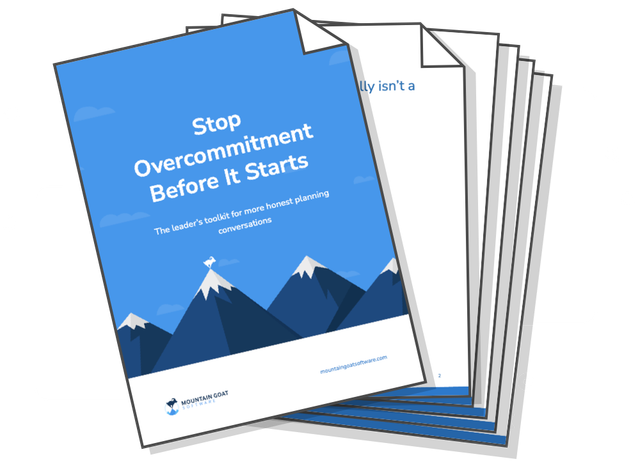
Overcommitment Toolkit for Leaders
FeaturedA short, practical resource to help leaders create more honest planning conversations when scope, dates, and commitments do not line up. Want a practical way to spot overcommitment before it starts?

Ask Better Planning Questions
FeaturedBetter planning starts with better questions. Leaders need plans.

Story Points
FeaturedStory points help agile teams estimate product backlog items by comparing one item with another. They are useful because teams rarely need perfect predictions.

Why Smart Teams Overcommit And How Leaders Make It Worse
Understand how leader pressure can push smart teams into unrealistic commitments.

Estimating and Planning in Agile: Why They Still Matter in 2026
By 2026, most agile practitioners have plenty of scar tissue when it comes to estimating and planning.

Leading Agile Initiatives: How Leaders Help Agile Change Succeed
An agile initiative is not mainly a one-time rollout of Scrum, Kanban, SAFe, Jira, new job titles, or a different meeting calendar.
We Tried Agile and It Didn’t Work
“We tried agile and it didn’t work” is one of the most revealing things a leader can hear.

Why Your Scrum Team Still Works Like Individuals
Learn how handoffs, individual task ownership, and status-report daily scrums keep Scrum teams from collaborating—and what to change next sprint.

How Much Can You Really Tinker with Scrum?
Does Scrum work if you don’t have a Scrum Master? What about sprints?

How to Get Teams Aligned on What It Means to Be Agile
Align leaders, teams, and stakeholders around what agile really means.

Should a Team Assign Work During Sprint Planning?
Some teams assign all tasks upfront. Others don’t.

7 Ways to Get the Best Estimates of Story Size
Agile teams often struggle to estimate product backlog items. Here are 7 ways to make solid improvements.


How to Estimate Story Points With Multiple Teams
Establishing a common baseline allows multiple teams to estimate consistently with story points.

Why Scrum Isn’t Working Even Though You’re Doing Scrum
Story splitting helps teams turn large user stories into smaller, valuable pieces they can finish within a sprint without turning them into tasks.

A Leader’s Guide to Agile
Learn the ten things agile teams need their leaders to understand, and how your actions can help them succeed. Get Mike Cohn’s free 91-page guide to the ten things agile teams most need their leaders to know.

Writing the Product Backlog Just in Time and Just Enough
Keep backlog detail just enough and just in time.

When Do Agile Teams Make Time for Innovation?
Make space for innovation inside short sprint cycles.

How to Use AI for Product Discovery and Writing Better User Stories
Use AI to support product discovery, user interviews, and writing better user stories.
When You Miss the Point of Sprint Planning Meetings
Refocus sprint planning on shared understanding, not exhaustive task prediction.